
Capabilities / How an order runs
How an order runs
Seven steps from your first message to a pallet of finished product, with your signature on two of them. Production is from 2 weeks; a ready-made formula removes most of what comes before it.
 7 stepsenquiry to delivery
 2 sign-offssample and artwork
 From 2 weeksyour own brand
 ISO 22000certified EU plant
From your first message to a pallet of finished product there are seven steps, and at two of them you sign something off. This page is what happens at each one and what it costs in time — because “from 2 weeks” is the production step alone, and the steps before it are where most first-time projects actually lose their month.
Seven steps, two signatures
Nothing is produced at scale before both of your sign-offs are in.
| Step | What happens | Ends with |
|---|---|---|
| 1. Enquiry | Format, active, dose, quantity, market | A quote |
| 2. Sample development | The formula is turned into a physical product | A sample |
| 3. Sample approval | Look, taste, dose and compliance are checked | Your sign-off |
| 4. Label approval | We design the artwork, or check yours | Your sign-off |
| 5. Manufacturing | The batch is produced at our plant | A finished batch |
| 6. Packing | Product is packed and labelled | Finished units |
| 7. Delivery | EXW at our EU plant by default; FCA or DAP quoted on request | A pallet |
What happens at each step
1. Enquiry
Tell us the format, the active and its dose, the quantity for the first run and the market you sell into. The market matters because label rules follow the country. If you are taking a ready-made formula, steps 2 and 3 shrink to picking the product and seeing a sample of it — most of the calendar disappears here.
2. Sample development
For a developed formula, this is where a specification becomes a physical product: the blend, the excipient system, the shell or the coating, the flavour if there is one. It is also where technical answers arrive — whether the dose fits the capsule size, whether the blend compresses into a stable tablet, whether the fill is compatible with the shell.
3. Sample approval
You approve the sample and we approve the compliance side. Both signatures are required before anything is produced at scale. This is the last cheap moment to change your mind: after it, a change means a new trial.
4. Label approval
We design the label and packaging artwork to the cutter guide of your pack, its exact shape, dimensions and safe areas, or check yours if you already have it. We check the artwork against Regulation (EU) 1169/2011 and Regulation (EC) 1924/2006 before it goes to print. A compliance problem caught here costs a redraw; caught after printing it costs the print run, and after production it costs the batch.
5. Manufacturing
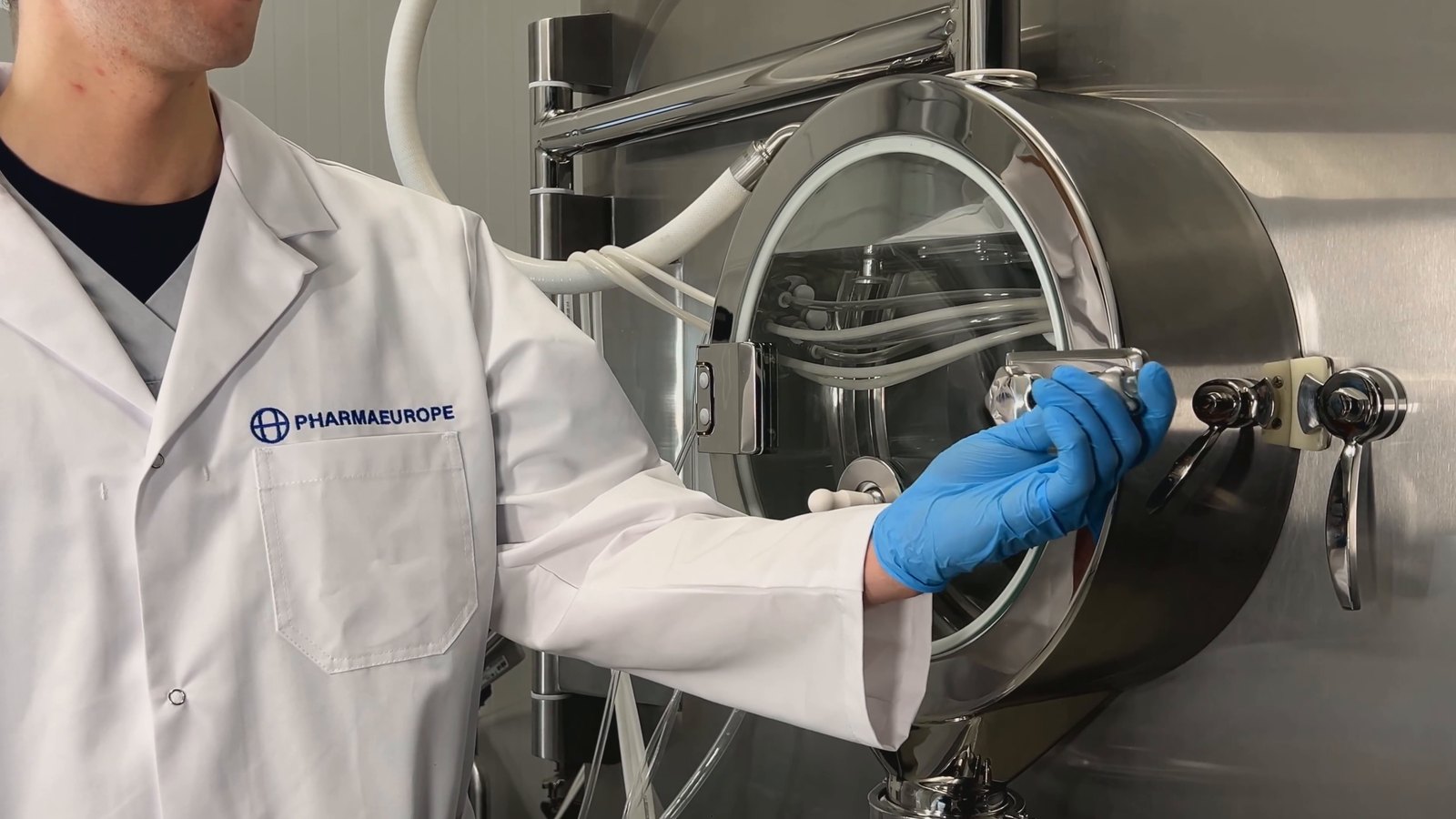
The batch is produced at our plant, under ISO 22000:2018 (valid to 7 January 2029) and HACCP under Regulation (EC) 852/2004, to the Food Supplements Europe GMP guide. The facility is registered with the US FDA as a food facility. Production time is from 2 weeks. A larger order does not run faster — it runs at a lower unit price.
6. Packing
Packing happens inside the same certified scope — the ISO 22000 certificate reads manufacturing and packaging of food supplements (tablets, capsules, powders); the other formats are packed at the same site under the same food-safety system. The pack options are on the packing page: PET and glass bottles, blisters with cartons, effervescent tubes, jars and zip-lock pouches.
7. Delivery
Finished pallets are handed over EXW at our plant: your forwarder collects them. FCA or DAP delivery to your address can be quoted on request.
“A batch does not leave the warehouse without a clean test report and a Certificate of Analysis. At the final stage we check the physical parameters — average weight, uniformity of mass and disintegration time; microbiological purity — yeasts and moulds within limits, no E. coli and no Salmonella — and heavy metals; the assay, meaning the real content of each active ingredient against what your label declares; and the seal — the induction membrane and the closure — so the product does not oxidise or take on moisture in transit.”
What you are responsible for, and what we are
- You are the food business operator whose name is on the label. You notify the product to your national authority before it goes on sale — supplements in the EU are not pre-approved at EU level: most Member States require a notification before sale — and you carry legal responsibility for the finished product on the market. In Spain the authority is AESAN.
- We are responsible for producing a product that matches the agreed specification, and for the documentation that demonstrates it. We supply what your notification needs.
- This split is the same for every contract manufacturer in Europe. It is written here because it is the question most first-time brands do not know to ask.
What you receive
- Certificate of Analysis
- Product specification
- Raw material documentation
- Allergen statement
- Shelf-life statement
About the process
How long does the whole thing take, not just production?
Production is from 2 weeks. Before it come sample development and two approval steps — the sample and the label artwork — and with a ready-made formula those are short, while with a formula developed from your brief they are the longer half of the project.
What do I have to sign off?
Two things: the sample and the label artwork. Nothing is produced at scale before both are signed off, which is why the approval steps sit before the production run rather than after it. After sign-off the specification is what gets made.
Who designs the label?
We do. The label and packaging are designed at the plant for your brand, to the cutter guide of the pack you have chosen; if you already have artwork, we check yours instead. We check it against Regulation (EU) 1169/2011 on food information and Regulation (EC) 1924/2006 on health claims before the print run, because a reprint costs more than a check does.
What happens if the sample is not right?
The sample goes back into development, and nothing is produced at scale until you approve a new one. That is the point of the step and the reason the approval sits before the production run: a formula is cheap to change at sample stage and expensive afterwards.
Can I change the formula after approval?
Not without a new sample and a new approval: once you have signed off the sample, that specification is what we manufacture, and a change to the composition restarts the sample and approval steps before production. A ready-made formula behaves the same way once it has been approved for your label.
Do you hold stock of finished products?
No — every batch is produced against an order and an approved specification, so nothing sits packed on a shelf waiting for a buyer. More than 500 ready-made formulas mean the recipe already exists, not that finished product does, which is why production still takes from 2 weeks.
Where is the product made?
Every batch is manufactured and packed at our plant, inside the European Union. Manufacturing and packing happen at the same site, which is what the ISO 22000 scope covers: manufacturing and packaging of food supplements.
How long does it take to produce supplements in Europe · Supplement batch release — what happens before products leave the factory · Quality control for supplement manufacturing in Europe · EU food supplement label requirements · Raw material documentation for food supplements
Capsules · Tablets · Softgels · Effervescent tablets · Powders · Sachets · Sports nutrition · Packing
Start your project
Tell us the format, the active, the dose and the quantity for the first run.
- Message us on WhatsApp