
Raw material documentation is one of the foundations of quality, traceability, and regulatory readiness in supplement manufacturing. Before any ingredient is approved for production, the manufacturer needs to understand what the material is, where it comes from, how it is produced, how it is tested, and whether it is suitable for the intended supplement format.
For private label supplement brands, documentation may seem like an administrative step. In practice, it directly affects formulation feasibility, quality control, regulatory review, label preparation, production planning, and finished product consistency.
In the EU market, food supplements are regulated as concentrated sources of nutrients or other substances intended to supplement the normal diet. EU Member States may also request notification when food supplements are placed on their markets, which makes raw material documentation important not only for production, but also for market preparation.
This guide explains the key raw material documents used in food supplement manufacturing and what brands should check before developing capsules, tablets, powders, sachets, effervescent tablets, or other supplement formats.
A raw material name alone is never enough.
Two ingredients with the same commercial name can differ significantly in source, concentration, purity, particle size, carrier system, extraction method, microbiological quality, and stability.
These technical differences can affect how the material behaves during blending, capsule filling, tablet compression, powder filling, flavour development, and storage.
Raw material documentation helps manufacturers verify:
For brands, this documentation helps reduce uncertainty before formulation, pricing, packaging procurement, and production planning begin.
The Certificate of Analysis, often called a CoA, is one of the most important raw material documents. It is a batch-specific document that confirms the analytical test results for a particular lot of raw material.
A CoA should not be treated as a general marketing document. It should correspond to the actual raw material batch supplied for production.
A professionally prepared CoA typically includes:
For example, if a botanical extract is standardised to a specific marker compound, the CoA should show the actual tested result for that batch. If a mineral ingredient is used as a source of magnesium, zinc, iron, or selenium, the CoA should support the relevant composition and quality parameters.
When reviewing a Certificate of Analysis, brands should pay attention to several practical points.
The batch number on the CoA should match the batch supplied by the raw material vendor. This connection is essential for traceability throughout the manufacturing process.
The CoA should include a clear manufacturing date, expiry date, or retest date. A CoA for an expired or unrelated batch should not be used as evidence for a current production lot.
Brands should be cautious with documents that only show “typical” or “theoretical” values. A useful CoA should include actual batch-specific test results, especially for assay, active markers, microbiological quality, heavy metals, and other relevant parameters.
The specification defines what the raw material should be. The CoA confirms what the tested batch actually contains. The document should clearly show whether the specific lot complies with the agreed specification.
Brands often confuse the Product Specification and the Certificate of Analysis, but they serve different purposes.
| Document Type | What It Shows | Why It Matters |
|---|---|---|
| Product Specification | The expected technical, physical, and quality parameters of the raw material | Used as the general approval standard and formulation reference |
| Certificate of Analysis | Batch-specific laboratory test results for one lot | Confirms whether that specific incoming batch complies with the specification |
| Supplier Declaration | A targeted statement regarding a specific status, such as allergen, GMO, vegan, origin, or BSE/TSE status | Supports label review, customer requirements, and quality documentation |
| Laboratory Test Report | Detailed internal, external, or third-party analytical results | Supports advanced testing such as contaminants, identity, assay, or irradiation review |
A complete raw material review usually requires both a Product Specification and a batch-specific CoA.
Different documents support different stages of raw material qualification. For food supplement brands, the documentation package should be reviewed according to the ingredient type, target market, and finished product format.
| Document Type | What It Validates | Key Elements to Verify |
|---|---|---|
| Technical Specification Sheet | General raw material benchmarks | Identity, active content, particle size, bulk density, moisture limits, storage conditions, shelf life |
| Certificate of Analysis | Batch-specific quality and composition | Batch number, assay, microbiology, heavy metals, moisture, compliance with specification |
| Allergen Statement | Presence or absence of relevant allergens | Alignment with EU allergen labelling requirements and the product allergen matrix |
| GMO Declaration | GMO status of the raw material | Traceability and supplier declaration |
| Vegan or Vegetarian Statement | Suitability for vegan or vegetarian positioning | Source material, carriers, processing aids, capsule shell, and coating compatibility |
| BSE/TSE Statement | Animal-origin risk assessment | Especially relevant for gelatin, collagen, bovine ingredients, and other animal derivatives |
| Pesticide or Contaminant Report | Contaminant status | Pesticides, heavy metals, mycotoxins, PAHs, or other material-specific risks |
| Residual Solvent Statement | Solvent residue status | Especially relevant for extracted botanical or specialised ingredients |
| Country of Origin Declaration | Supply chain transparency | Where the raw material was cultivated, harvested, extracted, processed, or packed |
| Stability or Shelf-Life Data | Ingredient stability expectations | Retest date, expiry date, storage conditions, stability support |
Allergen information is especially important for EU products because EU food information rules cover substances or products causing allergies or intolerances, including the allergens listed in Annex II of Regulation (EU) No 1169/2011.
The Technical Specification Sheet defines the expected chemical, physical, and quality parameters of an ingredient.
For manufacturers, this document is the benchmark for raw material approval. The Certificate of Analysis then confirms whether a specific incoming batch meets that benchmark.
A comprehensive technical specification usually includes:
Ingredient identity is especially important for complex natural materials. For botanical extracts, mushroom powders, probiotic cultures, and enzymes, a common market name is not enough.
Depending on the raw material, manufacturers may review:
For botanical materials, the same common name can describe very different materials. The plant part, extraction method, carrier, extract ratio, and standardised marker can all change the technical and regulatory profile of the ingredient.
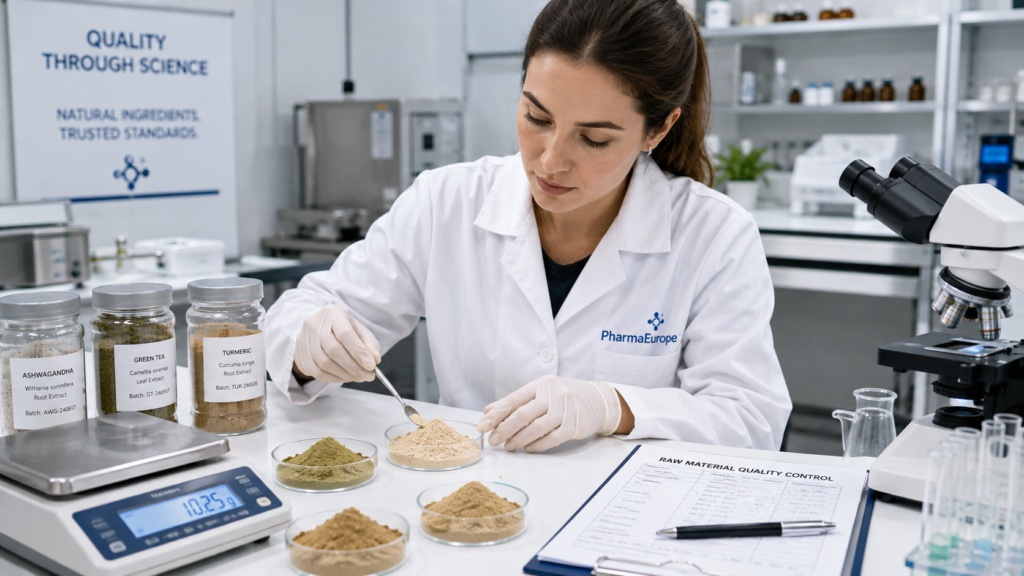
Botanical extracts and mushroom materials usually require deeper documentation review than standard vitamin or mineral raw materials.
For botanical extracts, manufacturers may review:
For mushroom ingredients, manufacturers may review:
This is especially important because two botanical or mushroom ingredients with the same commercial name may have different specifications. One extract may be defined mainly by an extraction ratio, while another may be standardised to a specific marker compound.
A high extraction ratio does not automatically indicate better quality. Manufacturers review the full documentation package to understand what the material actually is and whether it is suitable for the intended product. For a deeper formulation perspective, see our guide to Mushroom Ingredients in Food Supplements.
Many botanical extracts, mushroom extracts, and specialised raw materials are supplied as standardised ingredients.
Documentation should clearly show:
A 10:1 extract and a standardised extract with a defined marker level are not the same thing. The complete specification is needed to understand what is being standardised and how the material should be compared with alternatives.
Contaminant testing is an important part of raw material safety review. This is especially relevant for minerals, deep-root botanicals, mushrooms, algae-derived ingredients, plant powders, and materials from agricultural sources.
Key contaminant parameters may include:
EU food contaminant rules set maximum levels for certain contaminants in food, including metals such as lead, cadmium, mercury, arsenic, and inorganic tin. The European Commission states that food containing contaminants at unacceptable levels must not be placed on the market.
The level of testing required depends on the raw material type, supplier history, country of origin, product category, and intended market.
Microbiological quality is especially important for natural powders, botanicals, mushrooms, probiotics, enzymes, fibres, and other materials that may be more sensitive to microbial contamination.
A raw material CoA or test report may include:
Microbiological limits should be suitable for the ingredient and for the intended finished product format.
Residual solvent documentation may be relevant for extracted ingredients, especially botanical extracts and specialised raw materials produced using solvent-based processes.
The manufacturer may need to check:
For water extracts, this review may be less complex. For ethanol or other solvent-based extracts, the documentation becomes more important.
Country of origin can be relevant for supplier qualification, quality review, regulatory assessment, customer requirements, and brand positioning.
Brands may need to know:
This is especially important for botanicals, mushrooms, minerals, marine ingredients, algae ingredients, oils, and natural flavour systems.
Raw material stability data can influence the finished product shelf-life strategy.
A manufacturer should not assume a long finished product shelf life if the raw materials do not support it. This is especially relevant for moisture-sensitive powders, probiotics, enzymes, botanical extracts, mushroom extracts, effervescent ingredients, and oil-based materials.
Documentation should specify:
Moisture-sensitive ingredients may also require additional environmental controls during manufacturing and packaging.
Raw material documentation should support regulatory review for the intended market.
For EU supplement development, manufacturers may check:
For vitamins and minerals, the EU food supplement framework includes permitted vitamin and mineral substances that may be used for nutritional purposes in food supplements.
Novel Food review may be relevant when a food or ingredient does not have a significant history of consumption in the EU before 15 May 1997. The European Commission also notes that food business operators are responsible for verifying the status of foods placed on the market.
US or FDA-oriented documentation can be useful as supporting technical information, but it is not automatically sufficient for the EU market.
A raw material that is acceptable or documented for the United States market may still require EU-specific review. This may include checking:
For this reason, supplement brands planning to launch products in Europe should not rely only on US-oriented documentation. Raw materials should be reviewed specifically for the intended EU market.
Because raw material characteristics vary, a single documentation checklist cannot be applied identically to every ingredient.
| Ingredient Type | Key Documentation Focus |
|---|---|
| Vitamins | Exact nutrient form, assay, stability, permitted source |
| Minerals | Elemental content, purity, heavy metal testing, solubility |
| Botanical extracts | Botanical name, plant part, extraction ratio, marker content, solvent, pesticides |
| Mushroom ingredients | Species, fruiting body or mycelium source, beta-glucans, polysaccharides, extraction method |
| Probiotics | Strain identification, CFU count, overage, stability, storage conditions |
| Enzymes | Activity units, carrier system, stability, processing sensitivity |
| Amino acids | Assay, purity, particle size, solubility, taste profile |
| Oils and fatty acids | Peroxide and anisidine values, EPA/DHA content, source, odour control |
| Sweeteners and flavours | Additive or flavouring status, carrier, allergen status, solvent information |
| Excipients | Function, purity, compatibility, powder flow or tablet compression role |
This is why documentation review should be adapted to the ingredient category and final product format.
Documentation is essential, but it does not replace technical formulation testing.
A raw material may have a strong technical specification and a compliant CoA but still create production challenges, such as:
For this reason, raw material approval should combine documentation review with practical manufacturing evaluation.
Providing ingredient information early can improve pricing accuracy and project timelines.
When private label brands approach a manufacturer for a formulation or production quote, it is useful to prepare:
The more complete the information is, the more accurately the manufacturer can assess feasibility, pricing, timelines, and raw material documentation needs.
At PharmaEurope, raw material documentation is evaluated together with physical formulation feasibility.
Our quality and formulation review may include:
Where required, additional laboratory testing may be used to support raw material approval and finished product quality control.
This approach helps align ingredient selection, supplier documentation, manufacturing performance, quality review, packaging, and regulatory assessment before production begins.
A well-documented raw material is easier to evaluate and helps reduce reformulation risk, production delays, and uncertainty during product development.
Raw material documentation is a core part of professional food supplement manufacturing. It helps verify ingredient identity, composition, supplier reliability, contaminant status, regulatory suitability, and technical fit for the selected dosage form.
For private label supplement brands, documentation review should happen early in product development. A formula should not be assessed only by ingredient names or market trends. Product Specifications, batch Certificates of Analysis, allergen statements, contaminant data, storage conditions, shelf-life information, and EU market requirements all matter.
Strong documentation helps manufacturers reduce uncertainty, avoid unnecessary reformulation, support quality control, and develop supplement products that are realistic to produce and suitable for the intended market.
Raw material documentation is the complete set of technical, quality, safety, and regulatory data used to evaluate whether an ingredient is suitable for food supplement production.
A Product Specification defines the expected quality standard of the ingredient. A Certificate of Analysis provides the actual analytical test results for one specific batch.
A CoA confirms whether the specific lot of raw material delivered for production meets the required quality parameters, such as assay, moisture, heavy metals, and microbiological quality.
There is no single universal time limit. A CoA should correspond to the supplied batch and remain valid within the raw material’s shelf-life or retest period. Expired, unrelated, or generic documents should not be used as current batch evidence.
US or FDA documentation may be useful as supporting information, but it is not automatically sufficient for Europe. EU food supplement rules, Novel Food status, allergen requirements, contaminant limits, and national market requirements still need to be reviewed.
No. Documentation priorities depend on the ingredient type. Vitamins, minerals, botanical extracts, mushroom ingredients, probiotics, enzymes, flavours, and excipients all require different review points.
Country of origin can influence supplier qualification, regulatory review, contaminant risk assessment, customer requirements, and brand positioning.
Important documents may include botanical or fungal identity, plant part or mushroom source, extraction ratio, solvent information, marker compound results, pesticide testing, heavy metal results, microbiological data, identity testing, and a batch CoA.
Brands should provide the target ingredient list, desired dosages, dosage form, target markets, packaging preferences, clean-label or allergen requirements, and any available raw material documents.
No. Documentation is essential, but practical formulation testing is still needed to evaluate flowability, density, moisture sensitivity, compressibility, solubility, taste, colour, and compatibility.
© 2026 PharmaEurope.