
Knowledge 26 June 2026
Liposomal Ingredients in Food Supplements: Types, Formats and Manufacturing
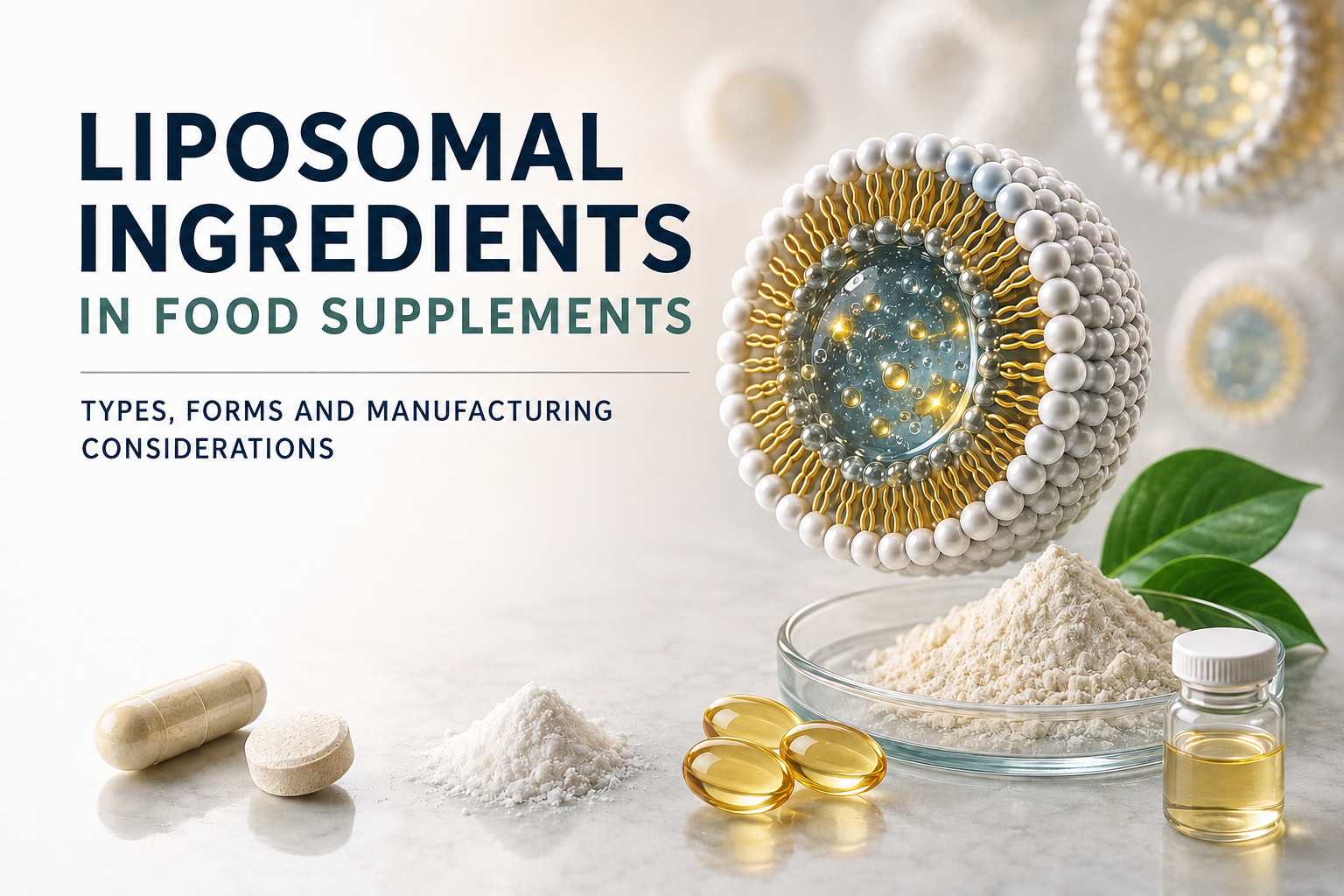
A liposomal ingredient is a vitamin, mineral or other active supplied together with a phospholipid carrier, and in production it is handled as its own raw material with its own specification, storage and pack. PharmaEurope already makes liposomal capsules at its EU plant, among them liposomal magnesium, liposomal vitamin D3 and liposomal coenzyme Q10. A ready-made formula under your label starts from 100 units, your own formula from 500 bottles; production takes from 2 weeks, your own formula from 4 weeks, and every batch ships with a Certificate of Analysis.
| Format | Minimum order | Production time | Liposomal products and projects |
|---|---|---|---|
| Capsules, ready-made formula with your label (white label) | From 100 units | From 2 weeks | Liposomal magnesium 75 mg, liposomal vitamin D3 4,000 IU, liposomal coenzyme Q10 50 mg |
| Capsules or tablets, your own formula (private label) | From 500 bottles | From 4 weeks, sample first | Another liposomal active, dose or combination |
| Powders and sachets | From 300 kg of finished blend | From 2 weeks; your own formula from 4 weeks | A liposomal powder inside a drink or sports blend |
| Syrups | From 100 L | From 2 weeks | A liposomal liquid, checked against the raw material's storage and stability data first |
Standard shelf life is 24 months, confirmed on the specification of each product. The plant is ISO 22000, GMP and HACCP certified and FDA registered; copies of the certificates are sent to clients on request.
What is a liposomal ingredient?
It is an active ingredient combined with phospholipids, compounds that can form microscopic structures around or with the active. In food supplements the result is usually sold as a finished raw material: a liposomal powder or a liposomal liquid.
Not all liposomal ingredients are made the same way. Suppliers use different phospholipid sources, encapsulation methods, carrier materials and drying technologies, so two liposomal ingredients with the same active can differ in active content, powder behaviour, storage needs and the formats they suit. That is why we evaluate each liposomal raw material on its own specification and never treat one supplier's liposomal vitamin C as a drop-in replacement for another's.
The phospholipid source matters for the label as well as for production. Phospholipids are commonly taken from lecithin, and when the lecithin comes from soy, soy has to be declared as an allergen under Regulation (EU) No 1169/2011. We ask for the source before the label is drafted, not after.
Which liposomal supplements can I launch under my own label?
Liposomal products are already in our catalogue of more than 500 ready-made formulas, so a liposomal line can start as white label from 100 units:
- liposomal magnesium 75 mg from liposomal citrate 656 mg, capsules;
- liposomal vitamin D3 4,000 IU (100 µg), vegetarian capsule;
- liposomal coenzyme Q10 50 mg, capsules;
- liposomal vitamin C;
- liposomal vitamin B complex;
- liposomal zinc;
- liposomal iron with vitamin C.
The magnesium, vitamin D and coenzyme Q10 products sit next to their conventional versions on our pages for private label magnesium supplements, private label vitamin D supplements and longevity supplement formulas, the page that also lists glutathione, PQQ and the other antioxidant formulas. A different liposomal active, dose or combination is made as your own formula from 500 bottles, sample first.
Why does a liposomal ingredient take more capsule space?
Because the carrier has weight and the label declares only the active. In our liposomal magnesium capsule, 656 mg of liposomal citrate gives 75 mg of magnesium; in our bisglycinate capsule, 500 mg of the ingredient gives 100 mg.
So the first figure we look for on a liposomal specification is the active content as a percentage of the powder. It sets the fill weight, the capsule size and the number of capsules per daily serving. A brief that asks for a high dose of a liposomal active can end up at several capsules a day, and that is something to decide before the label and the bottle count are designed. What the capsule route looks like in practice, from ready-made formulas to minimum order and lead time, is on our capsule manufacturing page.
Liposomal powder or liposomal liquid: which format?
For capsules, tablets and powder blends the raw material has to be a liposomal powder; a liposomal liquid belongs in a liquid product.
Liposomal powders are commonly used in:
- capsules
- tablets
- powders
- stick packs
They fit dry formulations, travel and store more easily than liquids and can usually go through the normal blending and filling process. Powders let a liposomal ingredient sit inside a sports or wellness blend; see private label powder manufacturing, minimum order from 300 kg.
Liposomal liquids are used in liquid supplements and syrups. They bring different stability needs, a pack that protects the liquid and controlled storage conditions, so we read the supplier's storage temperature and stability data before quoting. For the liquid route itself, see how we manufacture liquid supplements.
What goes wrong on the line with liposomal ingredients?
Mostly flow, heat and moisture. A liposomal raw material has to run through blending, filling or compression and packing like any other powder, and its fatty carrier makes that harder.
- Flow and sticking. Phospholipid-based powders can be soft and sticky, so they smear on tooling and fill unevenly. Flow aids and the order of blending are decided on a trial, not on paper.
- Compression. A tablet press puts pressure on the blend, and not every liposomal powder tolerates it. Capsules avoid the problem, which is why our liposomal magnesium, vitamin D3 and coenzyme Q10 are made as capsules.
- Moisture and oxygen. Phospholipids can take up moisture and oxidise, so exposure on the line and in the pack is kept short.
- Effervescent tablets. Not every liposomal ingredient suits an effervescent tablet; compatibility with water, acid and the carbonate system is checked for each ingredient.
What do we ask the liposomal ingredient supplier for?
A specification with the active content and the phospholipid composition, and a Certificate of Analysis for the lot we receive. Before a liposomal ingredient goes into a formula, the documents have to cover:
- active ingredient concentration;
- phospholipid source and composition, with the allergen status;
- carrier materials and other excipients in the raw material;
- stability information and storage requirements;
- recommended dosage forms;
- contaminant and microbiological limits.
Supplier brochures often describe liposomal technology in performance terms. That wording does not travel to the label: the label declares the ingredient and its amount, and any health-related wording is checked against the EU claims rules before it reaches the artwork.
How should a liposomal supplement be packed and stored?
In a pack that keeps moisture and oxygen out for the whole shelf life, chosen from the most sensitive ingredient in the formula. Depending on the formula, that means a bottle with a desiccant and a moisture-resistant closure, a high-barrier container or a blister. Our blister line forms PVC/PVDC and PVC/Aclar laminates and cold-formed aluminium for formulas that pull moisture or oxidise.
Temperature matters too: if the supplier sets a storage limit for the liposomal raw material, the finished product and its distribution have to respect it. Standard shelf life is 24 months, confirmed on the specification of the finished product. For more information, see our guide on Supplement Shelf Life in Europe: Stability, Testing and Expiry Explained.
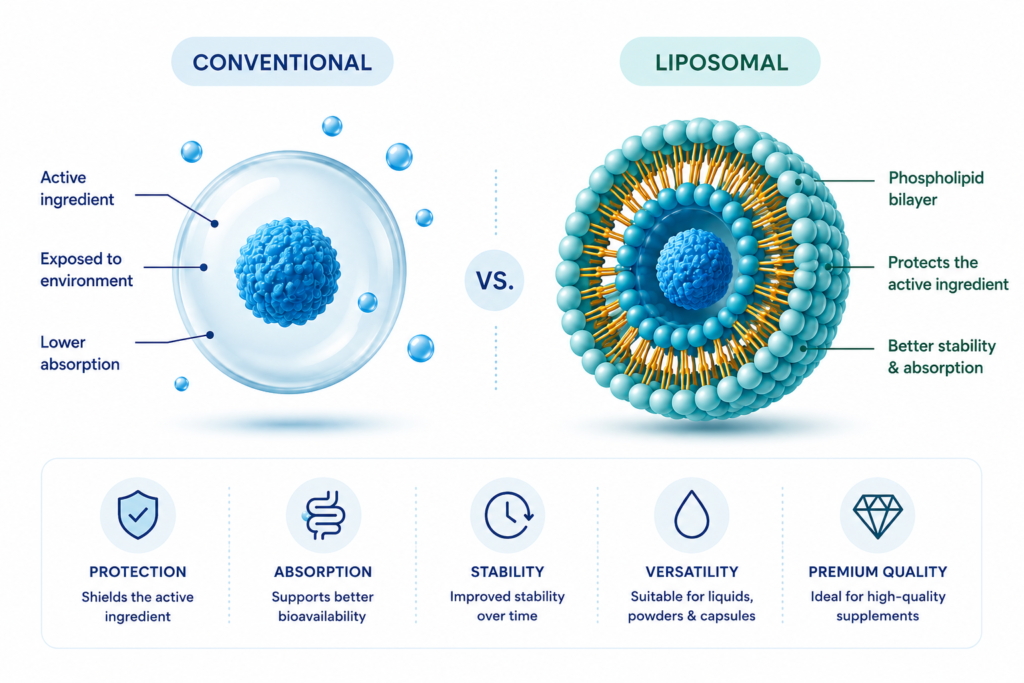
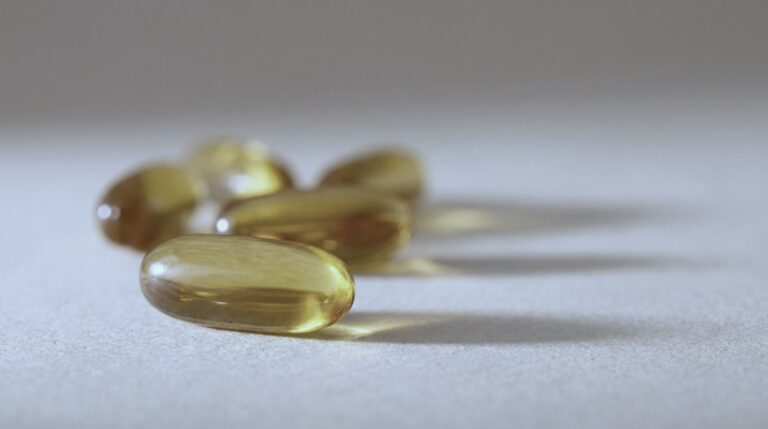
As illustrated above, liposomal ingredients are based on phospholipid carrier systems. Depending on the technology used, the structure, phospholipid composition and manufacturing process differ between ingredient suppliers.
FAQ
What are liposomal ingredients?
Liposomal ingredients are active ingredients supplied with a phospholipid-based carrier that forms part of the ingredient technology. They come as powders for capsules, tablets and powder blends, or as liquids for liquid products. Suppliers use different phospholipid sources and methods, so each liposomal raw material is judged on its own specification.
Which liposomal supplements does PharmaEurope already make?
PharmaEurope has liposomal magnesium 75 mg from liposomal citrate, liposomal vitamin D3 4,000 IU and liposomal coenzyme Q10 50 mg in capsules, plus liposomal vitamin C, vitamin B complex, zinc and iron with vitamin C in the catalogue. Any of them can carry your label from 100 units.
What is the minimum order for a liposomal supplement?
A ready-made liposomal formula with your label starts from 100 units, and your own liposomal formula in capsules or tablets from 500 bottles. A liposomal powder blend starts from 300 kg of finished blend and a syrup from 100 L. PharmaEurope counts every minimum per product, so two doses are two products.
How long does a liposomal supplement take to produce?
PharmaEurope produces a ready-made liposomal formula under your label from 2 weeks. Your own liposomal formula takes from 4 weeks, because a sample is made and approved before production. Every batch ships with a Certificate of Analysis, and standard shelf life is 24 months, confirmed on the specification of each product.
Can liposomal ingredients be used in tablets?
Some can, but not every liposomal powder tolerates the pressure of a tablet press, and the fatty carrier can stick to tooling. Capsules avoid both problems, which is why PharmaEurope makes its liposomal magnesium, vitamin D3 and coenzyme Q10 as capsules. A liposomal tablet is possible as your own formula after a trial shows the powder compresses well.
Do liposomal ingredients need special packaging?
They need packaging that keeps moisture and oxygen out for the full shelf life, and storage within the supplier's temperature limits. PharmaEurope chooses between a bottle with a desiccant, a high-barrier container and a blister in PVC/PVDC, PVC/Aclar or cold-formed aluminium, based on the most sensitive ingredient in the formula.
Does a liposomal ingredient change what the label can say?
No. The label declares the ingredient, for example liposomal magnesium citrate, and the amount of the active. Performance wording from supplier brochures is not an authorised claim. Any health-related wording is checked against the EU register of authorised claims before printing, and a soy-based phospholipid must be declared as an allergen.
Sources
- PharmaEurope catalogue of ready-made formulas: liposomal magnesium, vitamin D3, coenzyme Q10, vitamin C, vitamin B complex, zinc and iron, as named in the catalogue and on the magnesium, vitamin D and longevity pages.
- Regulation (EU) No 1169/2011 on food information to consumers, Annex II: substances causing allergies, including soybeans.
- Regulation (EC) No 1924/2006 on nutrition and health claims made on foods, and Regulation (EU) No 432/2012, the list of permitted health claims.
- PharmaEurope manufacturing equipment page: blister films.
Last checked: 26 October 2026.
Thinking about your own product? Tell us the format, the active and its dose, and how many units you need for the first run. Ready-made formulas start from 100 units, and we reply within 24 hours, Monday to Friday.
Written by the PharmaEurope manufacturing team at the ISO 22000-certified plant in the European Union. Last reviewed 26 October 2026.
Where this is made
Request a quoteReady-made formulas from 100 units. We reply within 24 hours, Monday to Friday.
Read next
 Private label vitamin D3 + K2 and vegan vitamin D3PharmaEurope makes private label vitamin D3 + K2 in softgels, tablets and effervescent tubes of 20, and vegan vitamin D3 from algae, at our EU plant. White label starts from 100 units, standard own-label runs from 500 bottles (500 pcs for stock softgels), your own brand on a ready-made formula is in production from 2 […]27 October 2026
 Why vitamin D is a strong first product for your supplement brandVitamin D is a strong first product for a new supplement brand because the ingredient is well known to buyers, the product is taken every day and the EU allows seven authorised health claims for it. PharmaEurope manufactures private label vitamin D in its certified EU plant: white label on a ready-made formula from 100 […]27 October 2026
 What vitamin D does and what an EU label may sayIn the EU, what vitamin D does may be stated on a supplement label only in the seven authorised health claims of Regulation (EU) No 432/2012, for example "Vitamin D contributes to the maintenance of normal bones", and only when a daily serving supplies at least 15 % of the 5 µg NRV, which is […]27 October 2026