
Knowledge 29 July 2026
Adaptogenic Ingredients in Food Supplements: Forms, Formats and Manufacturing
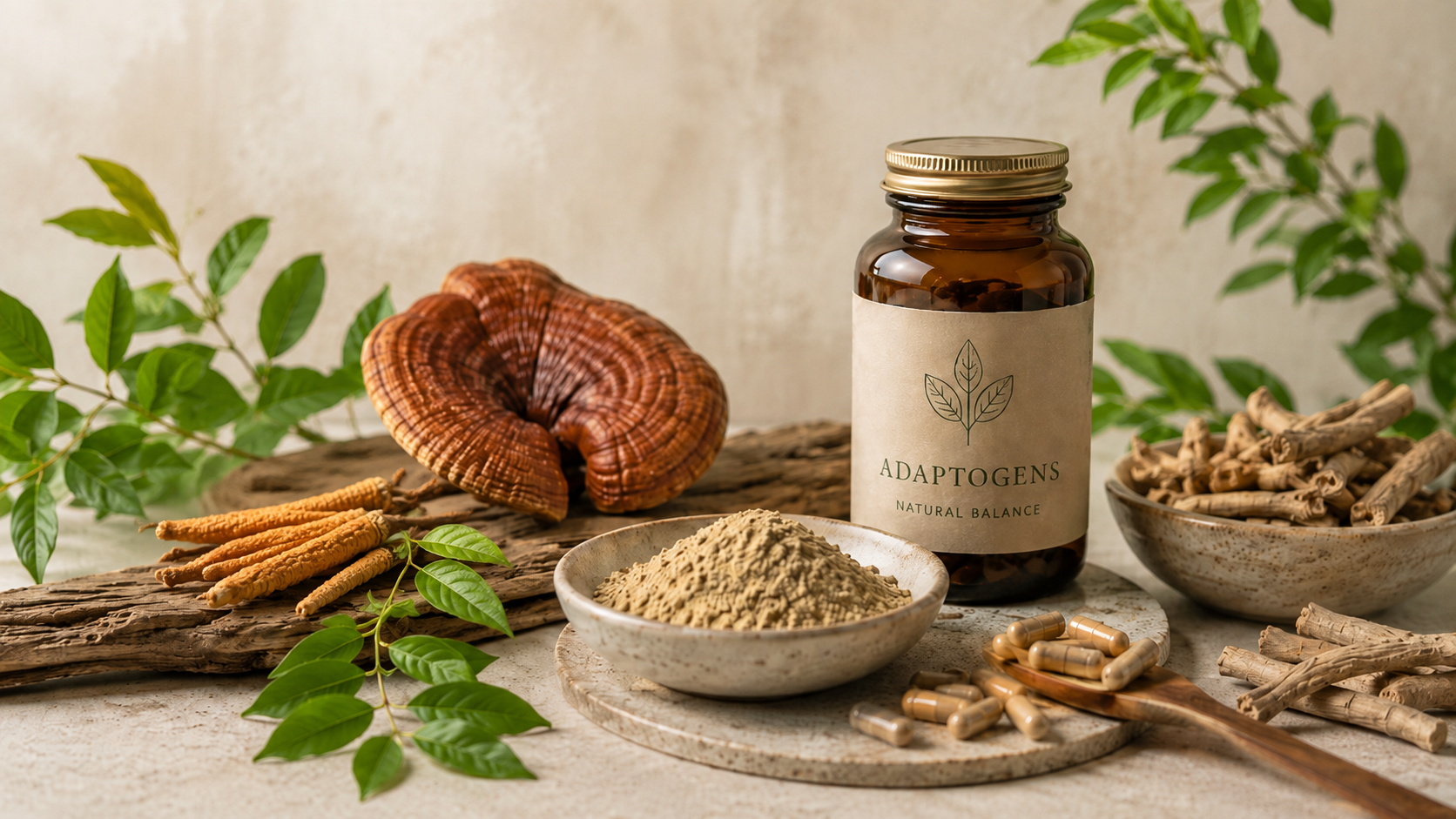
"Adaptogen" is a market label, not an ingredient class: it covers botanical roots, fruits and leaves and several mushrooms, and each one is specified, formulated and checked on its own. PharmaEurope makes these ingredients into capsules, tablets and powders at its EU plant. Ready-made formulas such as ashwagandha root capsules, maca root blends, reishi and cordyceps can carry your label from 100 units; your own formula starts from 500 bottles. Production takes from 2 weeks, your own formula from 4 weeks, and every batch ships with a Certificate of Analysis.
| Format | Minimum order | Production time | Adaptogen-positioned products and projects |
|---|---|---|---|
| Capsules, ready-made formula with your label (white label) | From 100 units | From 2 weeks | Ashwagandha root, maca root blends, reishi, lion's mane, four-mushroom blend |
| Tablets, ready-made formula with your label (white label) | From 100 units | From 2 weeks | Cordyceps |
| Capsules or tablets, your own formula (private label) | From 500 bottles | From 4 weeks, sample first | Rhodiola, eleuthero, schisandra, holy basil or your own combination |
| Powders and sachets | From 300 kg of finished blend | From 2 weeks; your own formula from 4 weeks | Drink powders and single-serve blends |
Standard shelf life is 24 months, confirmed on the specification. The plant is ISO 22000, GMP and HACCP certified and FDA registered; copies of the certificates are sent to clients on request.
Adaptogenic ingredients have become an increasingly visible category in modern food supplement development. They are incorporated into capsules, tablets, powders, sachets, stick packs, and multi-ingredient formulations intended for a wide range of product concepts.
What counts as an adaptogenic ingredient?
Any botanical or mushroom-derived ingredient the market places under that word; there is no chemical or regulatory definition behind it. Every raw material is therefore assessed on its own identity, composition, plant or fungal part, processing and regulatory status.
Commercial raw materials arrive as standardised extracts, concentrated dry extracts, whole plant powders, mushroom extracts, fruiting body materials or cultivated mycelium. Each behaves differently in blending, capsule filling, tablet compression, flavouring, storage and packing, and two materials with the same name can perform very differently on the line.
| Feature | Botanical ingredients | Mushroom-derived ingredients |
|---|---|---|
| Typical source | Roots, leaves, berries, bark, rhizomes or aerial plant parts | Fruiting body, cultivated mycelium or mushroom biomass |
| Common form | Whole plant powder or standardised extract | Powder, water extract or dual extract |
| Typical specification | Extract ratio or defined marker compounds | Extract ratio, beta-glucans or other supplier-defined markers |
| Common dosage forms | Capsules, tablets, powders and sachets | Capsules, powders, tablets and sachets |
| Key formulation factors | Taste, colour, density, flow and marker concentration | Moisture sensitivity, density, flow and extract specification |
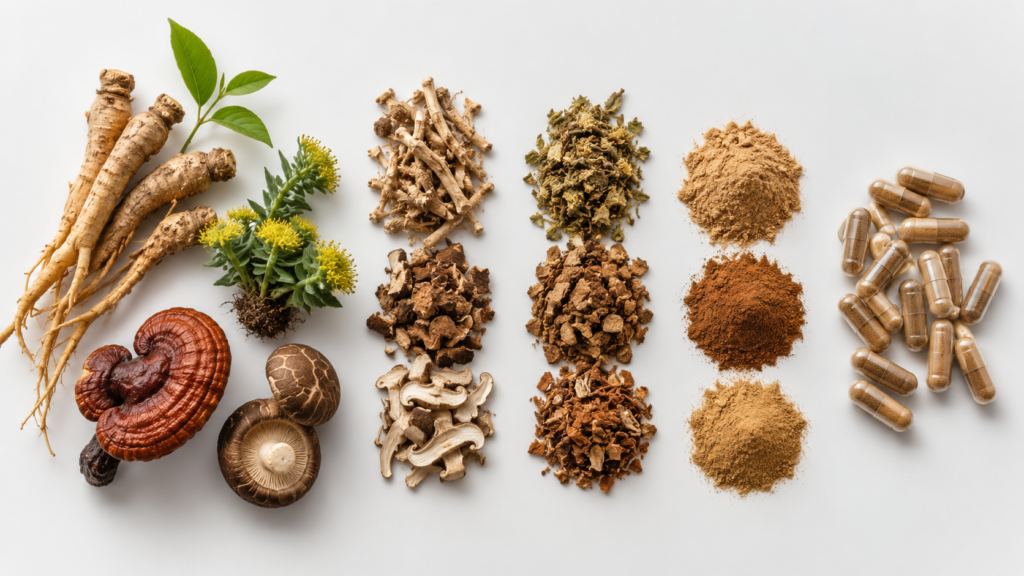
Which adaptogen supplements can I launch under my own label?
Ashwagandha root capsules, maca root blends and several mushroom formulas are already among our more than 500 ready-made formulas, so they can start as white label from 100 units.
- Botanicals: ashwagandha root capsules, tribulus and maca root blends; ashwagandha also sits inside a cell protection complex with NAC, coenzyme Q10, selenium, zinc and vitamins.
- Mushrooms: reishi, lion's mane and shiitake capsules, chaga with zinc, a cordyceps tablet and a four-mushroom blend.
All categories with their formulas are on our supplement ingredient categories page; the mushroom formulas and their EU status are on the private label mushroom supplements page, and the cell protection complex on the longevity supplements page. Rhodiola, eleuthero, schisandra, holy basil or a combination of your own is made as your own formula from 500 bottles: the raw material is checked first, then a sample is made and approved.
| Ingredient | Typical raw material form | Common specification |
|---|---|---|
| Ashwagandha (Withania somnifera) | Root powder or root extract | Extract ratio or withanolide content |
| Rhodiola (Rhodiola rosea) | Root and rhizome extract | Rosavins and salidroside |
| Eleuthero (Eleutherococcus senticosus) | Root powder or extract | Extract ratio or eleutherosides |
| Schisandra (Schisandra chinensis) | Fruit powder or extract | Extract ratio or schisandrins |
| Holy basil (Ocimum tenuiflorum) | Leaf or aerial-part powder or extract | Supplier-defined marker specification |
| Reishi | Fruiting body powder or extract | Beta-glucans, polysaccharides or triterpenes |
| Cordyceps | Cultivated material or extract | Named organism, extract ratio and supplier-defined markers |
| Lion's mane | Fruiting body powder or extract | Beta-glucans or other supplier-defined markers |
Being in this table does not give every extract, concentration, plant part or production method the same technical or regulatory status. Specifications vary between suppliers, so the choice is made on the full raw material documentation, not on the name.
Whole plant powder or standardised extract?
An extract when the serving has to fit in one or two capsules; a whole powder when the product is a powder blend or the brand accepts more capsules per serving.
Whole plant powders are dried and milled. They keep the broader plant matrix, need little processing and carry lower levels of marker compounds, so a serving is larger and batches vary more. Standardised extracts are concentrated and dried to a defined level of one or more markers, so the serving is smaller and batches are more consistent, but handling and storage are more specific.
Standardisation does not make extracts interchangeable. An extract ratio states how much dried starting material went into the extract; it does not confirm the level of any compound, nor purity or consistency. The markers usually specified are withanolides in ashwagandha, rosavins and salidroside in rhodiola, eleutherosides in eleuthero, schisandrins in schisandra and beta-glucans or triterpenes in mushrooms. To compare two extracts we read the ratio, the marker and its test method, the solvent, the carrier, moisture, density and particle size together.
Mushroom-derived ingredients add their own questions: fruiting body or mycelium, growth substrate, water or dual extraction, beta-glucans versus total polysaccharides. They are covered in our Mushroom Ingredients in Food Supplements: A Formulation Guide.
How are adaptogenic ingredients used across formats?
The format follows concentration and serving size: a concentrated extract may fit in one or two capsules, while the same concept built on whole plant powders needs more capsules or a powder serving.
Adaptogenic ingredients can be incorporated into several dosage formats:
- capsules;
- tablets;
- powder blends;
- sachets;
- stick packs;
- liquid extracts;
- functional beverages.
Capsules
Capsules take whole powders, extracts, mushrooms and multi-ingredient blends. Our line fills sizes up to 000, but a light botanical powder needs a larger capsule than a dense one at the same milligram dose, so density sets the daily capsule count more often than the machine does. Moisture sensitivity and compatibility with the capsule shell are checked as well. See how our capsule manufacturing line runs low-minimum private label projects.
Tablets
A tablet works when the extract compresses well. It may need binders, disintegrants, lubricants, glidants, fillers or a coating to reach suitable hardness, friability and disintegration. Our press makes tablets up to 25 mm, so the practical question is whether a consumer will swallow the tablet the dose requires, not whether the press can make it.
Powders
Powders take large quantities and complex blends, and they make taste, aroma, dispersibility, colour and sedimentation visible. Here is what our powder manufacturing line takes as a minimum order.
Sachets and stick packs
Sachets and stick packs provide individually portioned powder servings and reduce repeated exposure of the remaining product to ambient humidity after opening.
This is exactly how we run single-dose sachet manufacturing at our plant. Suitability depends on serving weight, powder flow, flavour system, filling accuracy and the barrier of the pack.
Effervescent tablets
Only some adaptogenic ingredients suit them. Strongly coloured, insoluble, bitter or highly hygroscopic extracts struggle in a 4 g tablet that has to dissolve in water and stay dry in a tube of 20 until use, so water dispersibility and the reaction with the acid-carbonate system are tested first.
What goes wrong on the line with adaptogenic extracts?
Moisture, flow and taste, in that order. Concentrated botanical and mushroom extracts often take up water from the air, which leads to caking, poor flow, sticking during filling or compression and changes during storage.
- Moisture. No single humidity limit fits every ingredient. We work from the supplier's moisture specification and storage guidance, keep exposure short and choose excipients and pack around the most sensitive material.
- Flow and density. Milled roots, spray-dried extracts and mushroom powders differ widely in density. A low-density extract fills a lot of volume for little weight, and poor flow causes bridging, segregation and uneven fills. Flow aids are added where the trial shows they are needed.
- Taste, colour and aroma. Bitter, earthy or woody notes hardly matter in a swallowed capsule and matter a lot in drink powders, sachets and effervescent tablets. Flavours, acidity regulators and sweeteners are added without making the serving larger than it needs to be.
- Batch colour. Natural raw materials vary in colour from lot to lot, which shows in powders, tablets and capsule fills; the specification states the accepted range.
The role of flow aids, binders and other functional materials is covered in Excipients in Supplement Manufacturing: Types, Functions and Formulation Role.
What do we ask the botanical supplier for?
A specification with the scientific name, the part used, the extraction and the marker, and a Certificate of Analysis for the lot. Before an adaptogenic raw material goes into a formula, the documents have to cover:
- scientific botanical or fungal name and the part used;
- country of origin;
- extraction method, extraction solvent and extract ratio;
- marker-compound specification and test method;
- microbiological criteria, heavy metals and pesticide residues;
- residual solvents, where applicable;
- allergen and GMO statements;
- storage requirements and shelf-life information.
Botanical identity can be supported by documentary, microscopic, chromatographic, genetic or other suitable methods, depending on the material and the risk. No single method fits every powder, extract or mushroom ingredient.
How should an adaptogen supplement be packed?
For the whole formula, against moisture, oxygen, light, temperature and repeated opening, not for one raw material.
Depending on the formula, that means PET or amber-glass bottles, desiccants, blisters, high-barrier pouches or individually sealed sachets. Our blister line forms PVC/PVDC and PVC/Aclar laminates and cold-formed aluminium for formulas that pull moisture or oxidise. Standard shelf life is 24 months, confirmed on the specification. The link between formula, pack, stability data and expiry is covered in Supplement Shelf Life in Europe: Stability, Testing and Expiry Explained.
Can the word "adaptogen" go on an EU label?
Not as an authorised health claim: the word describes an effect, and no claim built on it is authorised under Regulation (EU) No 432/2012.
A familiar plant name does not mean every extract, concentration, part or process has the same status. Before an adaptogen product goes to an EU market, the brand and PharmaEurope check:
- the status of every ingredient and the permitted use of the plant or mushroom in the destination country;
- the plant or fungal part and the extraction method;
- the intended daily quantity;
- possible novel food status;
- every label and advertising statement.
We check the artwork against the authorised wording before it goes to print. A formula that needs an authorised claim takes it from a vitamin or mineral it contains.
What should I send to get a quote for an adaptogen supplement?
The ingredients, the format, the serving and the market. With that, feasibility is checked before price, artwork, packaging and launch dates are fixed.
Product concept
- Target market or markets;
- preferred dosage form;
- target serving size and daily serving structure.
Ingredient direction
- Selected botanical or mushroom ingredients;
- whole powder or extract preference, extract ratio and marker standardisation;
- fruiting body or mycelium preference, where relevant.
Product characteristics
- Capsule or tablet count, or powder serving size;
- flavour and sweetener preference;
- clean-label requirements and preferred excipient approach.
Packaging
- Bottle, blister, pouch, stick pack, or sachet;
- required unit count or fill weight;
- multilingual labelling requirements;
- expected storage and distribution conditions.
FAQ
What are adaptogenic ingredients in food supplements?
It is a market term for selected botanical and mushroom-derived ingredients, such as ashwagandha, rhodiola, eleuthero, schisandra, reishi and cordyceps. It is not a chemical or regulatory class, so each material is evaluated on its own identity, plant or fungal part, extraction, specification and status in the intended market.
Which adaptogen products does PharmaEurope already make?
PharmaEurope has ashwagandha root capsules, tribulus and maca root blends, reishi, lion's mane and shiitake capsules, chaga with zinc, a cordyceps tablet and a four-mushroom blend among its ready-made formulas. Any of them can carry your label from 100 units, with production from 2 weeks.
What is the minimum order for an adaptogen supplement?
A ready-made formula with your label starts from 100 units. Your own formula in capsules or tablets, for example rhodiola or a combination of several botanicals, starts from 500 bottles and takes from 4 weeks. PharmaEurope makes powders and sachets from 300 kg of finished blend, and counts every minimum per product.
What is the difference between an extract ratio and standardisation?
An extract ratio describes how much dried starting material went into the finished extract. Standardisation sets the concentration of one or more marker compounds, such as withanolides in ashwagandha. A ratio alone does not confirm any compound level, so PharmaEurope compares extracts on the marker, its test method and the full specification.
Why are some adaptogenic extracts difficult to manufacture?
Many have low bulk density, poor flow, strong taste, intense colour or high moisture sensitivity. These properties cause caking, sticking and uneven fills, push a dose into more capsules and add flavour work in powders. PharmaEurope settles excipients, format and pack on a trial before the sample is approved.
Does the term "adaptogen" allow a health claim on the label?
No. No claim using the word is authorised under Regulation (EU) No 432/2012, and the status of each plant, part and extract still has to be checked for the destination country. PharmaEurope checks the artwork against the authorised wording before printing; a needed claim comes from a vitamin or mineral in the formula.
What documentation should come with adaptogenic ingredients?
A specification and a batch Certificate of Analysis, with the scientific name, part used, origin, extraction method and solvent, extract ratio, marker content, contaminant results, allergen and GMO statements and storage conditions. For the finished product, PharmaEurope ships a Certificate of Analysis with every batch and confirms the 24-month shelf life on the specification.
Sources
- Regulation (EU) No 432/2012 establishing a list of permitted health claims made on foods.
- Regulation (EU) 2015/2283 on novel foods.
- PharmaEurope catalogue of ready-made formulas, mushroom supplements page and longevity supplements page: formulas as named in the catalogue.
- PharmaEurope manufacturing equipment page: capsule sizes, tablet diameter, blister films; effervescent tablet page: 4 g tablets, tubes of 20.
Last checked: 26 October 2026.
Thinking about your own product? Tell us the format, the active and its dose, and how many units you need for the first run. Ready-made formulas start from 100 units, and we reply within 24 hours, Monday to Friday.
Written by the PharmaEurope manufacturing team at the ISO 22000-certified plant in the European Union. Last reviewed 26 October 2026.
Where this is made
Request a quoteReady-made formulas from 100 units. We reply within 24 hours, Monday to Friday.
Read next
 Private label vitamin D3 + K2 and vegan vitamin D3PharmaEurope makes private label vitamin D3 + K2 in softgels, tablets and effervescent tubes of 20, and vegan vitamin D3 from algae, at our EU plant. White label starts from 100 units, standard own-label runs from 500 bottles (500 pcs for stock softgels), your own brand on a ready-made formula is in production from 2 […]27 October 2026
 Why vitamin D is a strong first product for your supplement brandVitamin D is a strong first product for a new supplement brand because the ingredient is well known to buyers, the product is taken every day and the EU allows seven authorised health claims for it. PharmaEurope manufactures private label vitamin D in its certified EU plant: white label on a ready-made formula from 100 […]27 October 2026
 What vitamin D does and what an EU label may sayIn the EU, what vitamin D does may be stated on a supplement label only in the seven authorised health claims of Regulation (EU) No 432/2012, for example "Vitamin D contributes to the maintenance of normal bones", and only when a daily serving supplies at least 15 % of the 5 µg NRV, which is […]27 October 2026