
Adaptogenic ingredients have become an increasingly visible category in modern food supplement development. They are incorporated into capsules, tablets, powders, sachets, stick packs, and multi-ingredient formulations intended for a wide range of product concepts.
Unlike vitamins or minerals, adaptogenic ingredients do not form one chemically uniform group. The term is commonly used within the supplement industry for selected botanical and mushroom-derived ingredients that differ substantially in composition, extraction method, concentration, physical properties, and manufacturing behaviour.
Commercial raw materials may be supplied as standardized extracts, concentrated dry extracts, whole plant powders, mushroom extracts, fruiting body materials, or cultivated mycelium ingredients. Each format behaves differently during blending, capsule filling, tablet compression, flavour development, storage, and packaging.
This guide explains the main types of adaptogenic ingredients used in food supplements, how the available raw material forms differ, and what manufacturers evaluate before incorporating them into a finished formulation.
The term “adaptogen” is commonly used in the supplement market for selected botanical and mushroom-derived ingredients included in wellness-oriented formulations.
It is important to understand that adaptogenic ingredients do not represent one standardized chemical or regulatory class. Every raw material must be assessed according to its specific identity, composition, intended use, supplier documentation, processing method, and regulatory status.
Depending on the product concept, adaptogenic ingredients may be supplied as:
The most appropriate form depends on the target serving size, dosage form, ingredient concentration, formulation characteristics, and positioning of the finished product.
Adaptogenic raw materials can follow very different production routes depending on whether they originate from a botanical plant or a cultivated mushroom.
A simplified botanical ingredient process may include:
Mushroom-derived ingredients may additionally involve controlled cultivation of the fruiting body or mycelium, separation from the growth medium, and water or dual extraction.
The production process influences concentration, carrier content, particle characteristics, moisture sensitivity, taste, colour, and stability. Two materials with the same ingredient name may therefore perform very differently during supplement manufacturing.
Adaptogen-positioned formulations may contain botanical ingredients, mushroom-derived ingredients, or a combination of both.
| Feature | Botanical ingredients | Mushroom-derived ingredients |
|---|---|---|
| Typical source | Roots, leaves, berries, bark, rhizomes or aerial plant parts | Fruiting body, cultivated mycelium or mushroom biomass |
| Common form | Whole plant powder or standardized extract | Powder, water extract or dual extract |
| Typical specification | Extract ratio or defined marker compounds | Extract ratio, beta-glucans or other supplier-defined markers |
| Common dosage forms | Capsules, tablets, powders and sachets | Capsules, powders, tablets and sachets |
| Key formulation factors | Taste, colour, density, flow and marker concentration | Moisture sensitivity, density, flow and extract specification |
Neither category is automatically superior. Ingredient quality and manufacturing suitability must be assessed from the complete specification rather than from the ingredient name or marketing position alone.
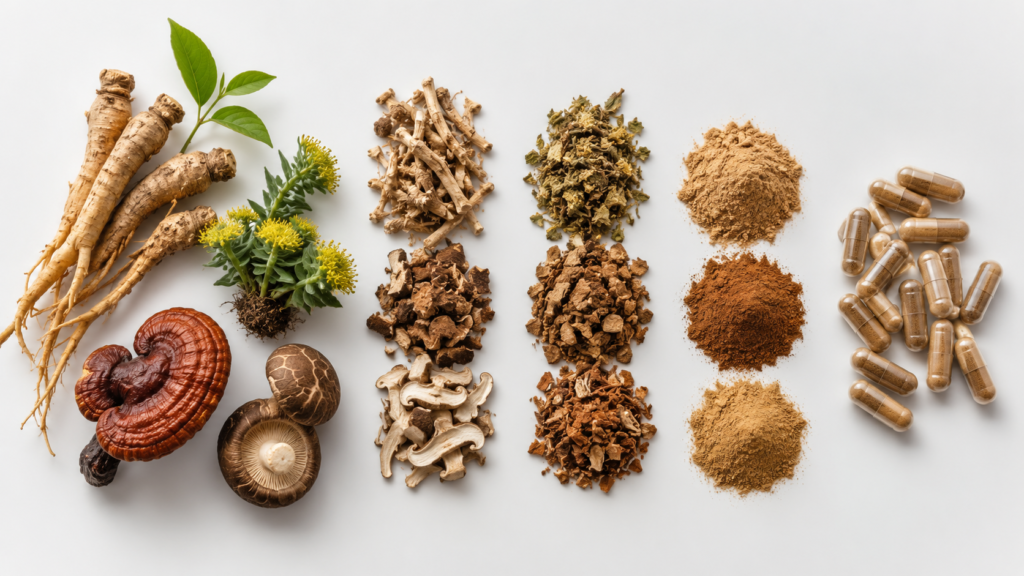
Several botanical and mushroom-derived materials frequently appear in modern adaptogen-oriented product concepts.
| Ingredient | Typical raw material form | Common specification |
|---|---|---|
| Ashwagandha (Withania somnifera) | Root powder or root extract | Extract ratio or withanolide content |
| Rhodiola (Rhodiola rosea) | Root and rhizome extract | Rosavins and salidroside |
| Eleuthero (Eleutherococcus senticosus) | Root powder or extract | Extract ratio or eleutherosides |
| Schisandra (Schisandra chinensis) | Fruit powder or extract | Extract ratio or schisandrins |
| Holy Basil (Ocimum tenuiflorum) | Leaf or aerial-part powder or extract | Supplier-defined marker specification |
| Reishi | Fruiting body or mycelium powder or extract | Beta-glucans, polysaccharides or triterpenes |
| Cordyceps | Cultivated material or extract | Extract ratio and supplier-defined markers |
| Lion’s Mane | Fruiting body or mycelium powder or extract | Beta-glucans or other supplier-defined markers |
The inclusion of an ingredient in this table does not mean that every extract, concentration, plant part, or production method has the same technical or regulatory status.
Actual specifications vary between suppliers. Ingredient selection should therefore be based on the complete raw material documentation rather than on the botanical or mushroom name alone.
One of the first decisions in adaptogenic supplement formulation is whether to use a whole plant powder or a concentrated extract.
Whole plant powders are produced by drying and milling the selected botanical material.
They generally offer:
Because they usually require more material per serving, whole plant powders may be more practical in powder blends or multi-capsule products than in compact single-capsule formulations.
Standardized extracts are produced through controlled extraction, concentration, and drying processes.
They may provide:
Standardization does not make extracts interchangeable. Product developers must still compare the extraction ratio, marker concentration, extraction solvent, carrier system, moisture specification, density, particle size, and full supplier documentation.
These differences are examined more broadly in our guide to Botanical Extracts in Food Supplements, including how extract ratios and standardized marker compounds should be interpreted during raw material selection.
Botanical extracts are often described by an extract ratio, a marker-compound specification, or both.
An extract ratio such as 10:1 indicates the approximate relationship between the quantity of starting botanical material and the quantity of finished extract.
However, an extract ratio alone does not confirm the concentration of particular naturally occurring compounds. It also does not automatically demonstrate greater purity, consistency, or manufacturing quality.
Commonly specified markers may include:
A technically meaningful comparison therefore requires the complete ingredient specification rather than a comparison based only on which material carries the highest extraction ratio.
Mushroom-derived ingredients require their own technical evaluation.
Depending on the mushroom species and supplier, the assessment may include:
Beta-glucans and total polysaccharides should not automatically be treated as equivalent measurements. The analytical method and complete raw material documentation matter when comparing mushroom ingredients.
Our Mushroom Ingredients in Food Supplements: A Formulation Guide examines fruiting body, mycelium, whole mushroom powders, water extracts, and dual extracts in greater detail.
Adaptogenic ingredients can be incorporated into several dosage formats:
The selected format depends on concentration, target serving size, flavour profile, physical characteristics, compatibility with other ingredients, and manufacturing feasibility.
A concentrated extract may fit into one or two capsules, while an equivalent concept based on whole plant powders may require a larger capsule count or a powder serving.
Liquid extracts and beverage powders introduce additional considerations related to flavour, solubility, preservation, sedimentation, colour, and packaging.
Adaptogenic extracts and whole plant powders can vary substantially in their physical behaviour.
Technical evaluation commonly includes:
These properties determine whether a raw material can be blended, encapsulated, compressed, filled, and packaged consistently.
Some concentrated botanical and mushroom extracts readily absorb moisture from the surrounding environment.
Excessive moisture exposure may contribute to:
The required controls depend on the individual material and production process. Hygroscopic ingredients may require limited exposure to ambient humidity, controlled production conditions, suitable functional excipients, and protective packaging.
A single humidity limit cannot be applied to every adaptogenic ingredient. Supplier storage guidance, raw material moisture specifications, the complete formulation, and the intended manufacturing process must all be considered.
Whole plant powders, milled roots, spray-dried extracts, and mushroom materials may have very different densities and flow properties.
A low-density extract can occupy considerable volume even when its weight is relatively small. This directly affects:
Poor-flowing materials may also bridge, stick, or segregate during manufacturing.
Where appropriate, suitable functional excipients may be introduced to improve flow, blend consistency, compression, or filling performance. The role of these materials is explained further in Excipients in Supplement Manufacturing: Types, Functions and Formulation Role.
Adaptogenic ingredients often have naturally bitter, earthy, astringent, woody, or strongly aromatic sensory characteristics.
These properties may be less noticeable in swallowed capsules but can strongly influence:
For open-dose products, formulation teams may evaluate flavour systems, acidity regulators, sweeteners, and masking ingredients. The objective is to improve consumer acceptability without making the serving unnecessarily large or the formula unnecessarily complex.
Colour also requires attention. Botanical and mushroom extracts can noticeably affect the appearance of powders, tablets, capsule fills, and prepared drinks. Some natural colour variation may occur between raw material batches and should be considered during development.
Capsules provide substantial flexibility for whole plant powders, standardized extracts, mushroom ingredients, and multi-ingredient blends.
Key considerations include:
A highly concentrated extract may fit into a compact capsule formulation, whereas a formula based on several whole plant powders may require multiple capsules per serving.
Selected adaptogenic ingredients can be incorporated into tablets when their compression characteristics and formulation compatibility are suitable.
Tablet formulations may require carefully selected:
The final tablet must achieve suitable hardness, friability, disintegration, and physical stability without creating an impractically large product.
Powders can accommodate larger ingredient quantities and complex blends. They may therefore be appropriate when the intended serving cannot fit into a practical number of capsules or tablets.
However, powder formats make the following factors more visible:
Sachets and stick packs provide individually portioned powder servings and reduce repeated exposure of the remaining product to ambient humidity after opening.
Their suitability depends on:
Only selected adaptogenic ingredients are suitable for effervescent formulations.
Before development, the manufacturer must assess:
Strongly coloured, insoluble, bitter, or highly hygroscopic extracts can create significant formulation challenges in this format.
Packaging forms part of the formulation strategy for adaptogenic products.
The complete product may need protection from:
Depending on the formula, suitable packaging may include:
The final packaging configuration should reflect the stability needs of the whole formulation rather than those of only one raw material.
This relationship between formulation, packaging, stability data, and expiry expectations is covered in Supplement Shelf Life in Europe: Stability, Testing and Expiry Explained.
Raw material qualification begins before manufacturing.
For adaptogenic ingredients, documentation commonly includes:
Depending on the material and risk assessment, botanical identity may be supported through documentary, microscopic, chromatographic, genetic, or other suitable analytical methods.
No single identity or quality-control method is universally appropriate for every botanical powder, concentrated extract, or mushroom ingredient.
The word “adaptogen” is widely used within the supplement industry, but it should not be treated as an automatically authorised health claim.
Before placing a product on an EU market, brands should evaluate:
A familiar plant name does not mean that every extract, concentration, plant part, or manufacturing process has the same regulatory status.
Health-related wording must be reviewed separately for the intended market. Formula development, labelling, and marketing communication should therefore be aligned early rather than assessed only after the formula and packaging have been finalized.
At PharmaEurope, adaptogenic raw materials are evaluated within the context of the complete product rather than by ingredient name alone.
The technical review may include:
Where appropriate, alternative raw materials, ingredient concentrations, or excipient systems may be evaluated according to the customer’s product objectives and technical requirements.
This approach helps align ingredient selection, manufacturing feasibility, stability, packaging, and the intended consumer format before production begins.
Before requesting a formulation or quotation, brands should define the following information.
Providing this information early allows the manufacturer to evaluate technical feasibility before pricing, artwork, packaging procurement, and launch timelines are finalized.
Adaptogenic ingredients represent a diverse collection of botanical and mushroom-derived raw materials rather than one uniform ingredient category.
Successful product development involves much more than choosing a familiar ingredient name. Botanical or fungal identity, plant part, extraction method, standardization, concentration, physical behaviour, taste, moisture sensitivity, dosage-form compatibility, supplier documentation, packaging, and regulatory status must all be considered.
Brands that evaluate these factors early are better positioned to develop clearly specified, technically feasible, stable, and manufacturable food supplements for their intended EU markets.
The term is commonly used within the supplement industry for selected botanical and mushroom-derived ingredients included in wellness-oriented formulations. Each material must be evaluated according to its individual identity, specification, intended use, and regulatory status.
No. They may be supplied as standardized extracts, concentrated dry extracts, whole plant powders, mushroom extracts, fruiting body materials, or cultivated mycelium ingredients.
An extract ratio describes the approximate relationship between the starting botanical material and the finished extract. Standardization defines the concentration of one or more selected marker compounds within the ingredient.
Some materials have low bulk density, poor flow, strong taste, intense colour, or high moisture sensitivity. These properties can affect blending, capsule filling, tablet compression, flavour development, processing consistency, and packaging.
Many can, but suitability depends on the specific raw material, concentration, dosage, physical characteristics, formulation, and stability requirements.
They can often be incorporated into combination formulas, but serving size, ingredient compatibility, sensory properties, density, processing behaviour, and regulatory status must be assessed for the complete formulation.
Not automatically. Any proposed health-related wording must be reviewed under the applicable EU and national requirements for the intended market.
Manufacturers generally review specifications, batch Certificates of Analysis, identity information, extract details, marker content, contaminant testing, storage requirements, shelf-life information, and other relevant supplier documents.
© 2026 PharmaEurope.