
Mushroom ingredients have become an important category in modern food supplement development. They are used in capsules, tablets, powders, sachets, and functional nutrition products, often as part of broader botanical or wellness-oriented formulations.
For supplement manufacturers, mushroom ingredients require careful technical evaluation. The species name alone is not enough. The ingredient source, extraction method, standardization, particle size, moisture level, bulk density, and supporting documentation all influence how the material performs in production.
This formulation guide explains the main types of mushroom ingredients used in food supplements, the difference between powders and extracts, the role of beta-glucans and polysaccharides, and the key manufacturing factors to consider when developing mushroom-based products.
Mushroom ingredients are raw materials produced from selected fungal species for use in food supplement manufacturing.
Depending on the intended product concept, dosage form, and raw material specification, mushroom ingredients may be supplied as:
Each format has different formulation characteristics. Some are better suited for capsules, others for powders, tablets, or single-dose sachets. The right choice depends on dosage requirements, raw material quality, production feasibility, packaging format, and the final product positioning.
One of the first technical decisions in mushroom ingredient selection is the source of the material.
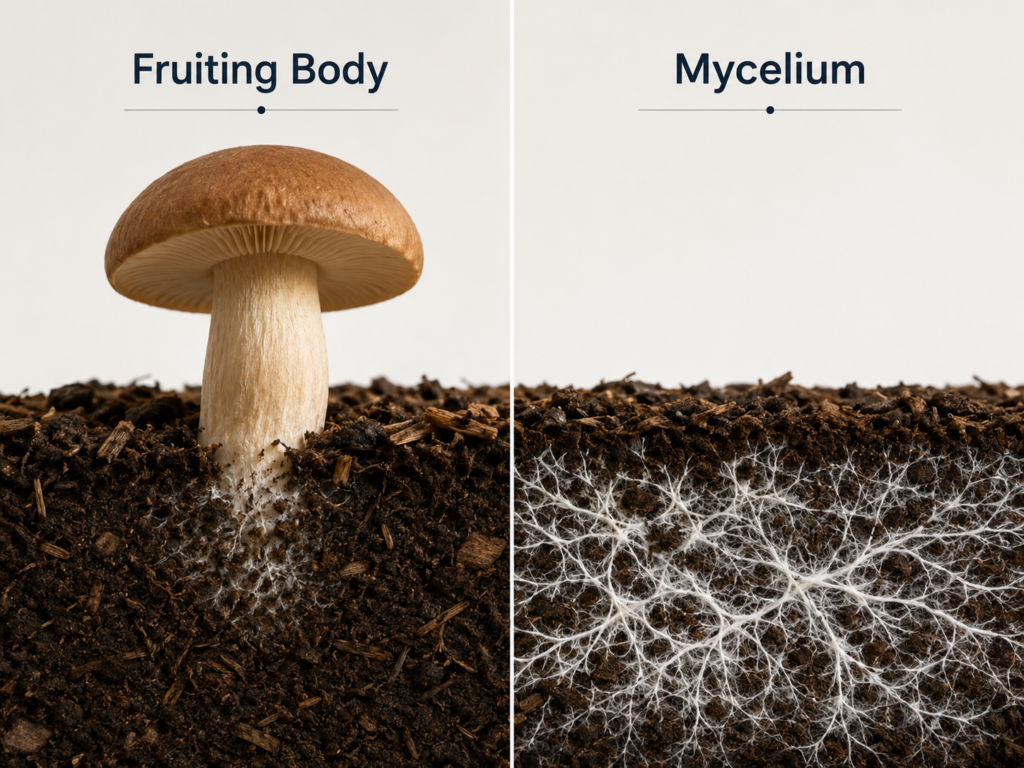
The fruiting body is the mature visible mushroom structure. It is widely used for mushroom powders and concentrated extracts. Fruiting body materials are often selected when the formulation requires a clearly defined source and a more traditional ingredient profile.
Mycelium is the vegetative filament network of the fungus. It is typically produced under controlled cultivation conditions and may be supplied as powder or extract. Depending on the supplier and production method, mycelium-based materials can vary significantly in composition.
| Feature | Fruiting Body | Mycelium |
| Source | Mature mushroom structure | Vegetative fungal network |
| Common Use | Powders and extracts | Powders and extracts |
| Production Method | Cultivation and harvesting | Controlled cultivation |
| Key Evaluation Point | Species, plant part, standardization | Substrate, purity, specification |
For manufacturers, the most important factor is not only whether the material comes from fruiting body or mycelium, but whether the supplier can provide a clear specification, reliable batch documentation, and consistent quality.
Whole mushroom powders and mushroom extracts may come from the same species, but they behave very differently in formulation and production.
Whole mushroom powders are produced by drying and milling the raw material. They usually contain the natural full matrix of the mushroom, but with limited concentration.
They are commonly used in:
Because they are less concentrated, whole powders often require larger serving sizes. This can be a challenge in capsule or tablet formats.
Mushroom extracts are produced through extraction and drying processes that concentrate selected fractions of the raw material.
They are commonly used in:
Extracts are often preferred when a smaller serving size is required or when the formula needs a defined marker level, such as beta-glucans.
| Feature | Whole Mushroom Powder | Mushroom Extract |
| Processing | Drying and milling | Extraction and drying |
| Concentration | Lower | Higher |
| Serving Size | Usually larger | Usually smaller |
| Standardization | Limited | More precise |
| Manufacturing Use | Powders, larger capsules | Capsules, tablets, sachets |
When evaluating mushroom ingredients, beta-glucans and polysaccharides are often mentioned in raw material specifications. Although these terms are sometimes used together, they are not the same.
Polysaccharides are a broad group of carbohydrate structures naturally present in mushroom materials. A total polysaccharide value gives a general indication of this broader carbohydrate fraction.
However, total polysaccharides may include different types of carbohydrates and are not always specific enough for precise ingredient comparison.
Beta-glucans are a more specific subgroup of polysaccharides. In mushroom ingredient specifications, beta-glucan content is often used as a more targeted quality marker.
For formulation and quality control, beta-glucan standardization is usually more informative than total polysaccharide content alone.
Two mushroom extracts may both be described as “30% polysaccharides”, but their beta-glucan content can be very different. This means the technical quality and formulation value of the ingredients may not be equivalent.
When selecting mushroom raw materials, manufacturers should review:
For B2B supplement development, a clear distinction between beta-glucans and total polysaccharides helps avoid misleading comparisons between raw materials.
The extraction method has a major impact on the final ingredient profile, solubility, taste, colour, and formulation behaviour.
Water Extracts
Water extraction is commonly used to obtain water-soluble fractions from mushroom materials. These extracts are often used in capsules, powders, and sachets.
Water extracts may be suitable when the formulation requires:
Dual Extracts
Dual extraction combines water extraction with food-grade ethanol extraction. This method is often used when a broader raw material profile is required.
Dual extracts may be selected for specific mushroom species where both water-soluble and ethanol-soluble fractions are relevant to the raw material specification.
From a manufacturing perspective, dual extracts must be evaluated carefully for:
Different mushroom species are used in different supplement concepts and dosage formats. The table below provides a practical overview from a formulation perspective.
| Mushroom Ingredient | Common Raw Material Form | Typical Supplement Formats |
| Lion’s Mane | Powder, standardized extract | Capsules, tablets, powder blends |
| Reishi | Powder, water extract, dual extract | Capsules, tablets, powder blends |
| Cordyceps | Powder, water extract | Capsules, powder blends |
| Chaga | Powder, water extract, dual extract | Capsules, powder blends, sachets |
| Shiitake | Powder, water extract | Capsules, tablets |
| Turkey Tail | Water extract | Capsules, tablets |
| Maitake | Powder, standardized extract | Capsules, tablets |
The final choice depends on the required dosage, raw material specification, product format, and production feasibility.
Standardized mushroom extracts are used when brands require a defined marker level in the raw material. Standardization helps improve consistency between batches and supports more predictable formulation development.
When reviewing standardized mushroom extracts, manufacturers should evaluate:
A high extraction ratio does not automatically mean a better ingredient. The full specification must be reviewed together with the test method and quality documentation.
Mushroom ingredients can be technically challenging to manufacture. Many mushroom powders and extracts are hygroscopic, meaning they absorb moisture from the air. This can cause clumping, poor flow, sticking, and weight variation during production.
Key formulation factors include:
Poor powder flow can create problems during capsule filling, tablet compression, or sachet filling. Flowability must be assessed before production.
Mushroom powders can be light and fluffy. This affects capsule size, tablet weight, and powder serving volume.
Moisture-sensitive mushroom ingredients may require controlled humidity conditions and protective packaging.
Mushroom extracts may have a strong taste, dark colour, or earthy profile. This is especially important in powder blends and sachets.
Mushroom ingredients must be assessed together with vitamins, minerals, amino acids, flavours, sweeteners, and excipients used in the same formulation.
Capsules are one of the most common formats for mushroom ingredients. They are suitable for both powders and extracts, especially when the formula requires a clean label-style presentation and a dry dosage form.
However, capsule size must be checked carefully. Large mushroom dosages may require bigger capsules or multiple capsules per daily serving.
Tablets can be used for selected mushroom formulations, but not all mushroom ingredients are easy to compress. Some materials may require binders, fillers, anti-caking agents, or additional formulation work to achieve acceptable tablet hardness and stability.
Powder blends are suitable for larger mushroom serving sizes and multi-ingredient concepts. They can be packed in jars or pouches and used in drinks, smoothies, coffee-style products, or functional nutrition formulations.
Taste, solubility, colour, and mouthfeel are especially important in this format.
Flat single-dose sachets are suitable for pre-measured mushroom powder blends. They are useful when the formulation requires portion control and improved protection from moisture exposure before use.
Before mushroom ingredients are approved for production, the raw material documentation should be reviewed carefully.
Typical documentation includes:
Documentation quality is especially important for mushroom ingredients because composition can vary depending on species, source material, cultivation method, extraction process, and standardization.
At PharmaEurope, mushroom ingredient projects are evaluated from a practical manufacturing perspective. A good mushroom formula is not only about selecting a popular ingredient. It must also be technically suitable for production, stable in the selected dosage form, and supported by proper documentation.
When developing mushroom-based food supplements, we assess:
This approach helps create food supplement formulations that are realistic for production and suitable for commercial private label projects.
| Category | Technical Mushroom Ingredients |
| Raw Material Forms | Whole mushroom powder, concentrated extract, standardized extract |
| Common Sources | Fruiting body, mycelium-derived material |
| Extraction Methods | Water extraction, dual extraction |
| Key Markers | Beta-glucans, total polysaccharides |
| Common Formats | Capsules, tablets, powders, flat sachets |
| Manufacturing Complexity | Medium |
| Main Technical Challenge | Moisture sensitivity and powder flow |
| Packaging Importance | High |
Selecting the right mushroom ingredient early in the development process helps avoid production delays, reformulation work, and packaging issues.
A practical selection checklist includes:
Mushroom ingredients offer strong formulation flexibility for modern food supplement development. They can be used in capsules, tablets, powders, and flat sachets, depending on the selected species, extract type, dosage, and technical specification.
For successful product development, manufacturers should evaluate more than the mushroom name. The source material, extraction method, beta-glucan content, total polysaccharides, flowability, moisture sensitivity, and documentation all play an important role.
A well-designed mushroom supplement starts with the right raw material and a formulation strategy that fits the selected dosage form.
© 2026 PharmaEurope.