
Knowledge 16 June 2026
Mineral Ingredients in Food Supplements: Forms, Elemental Content and Manufacturing
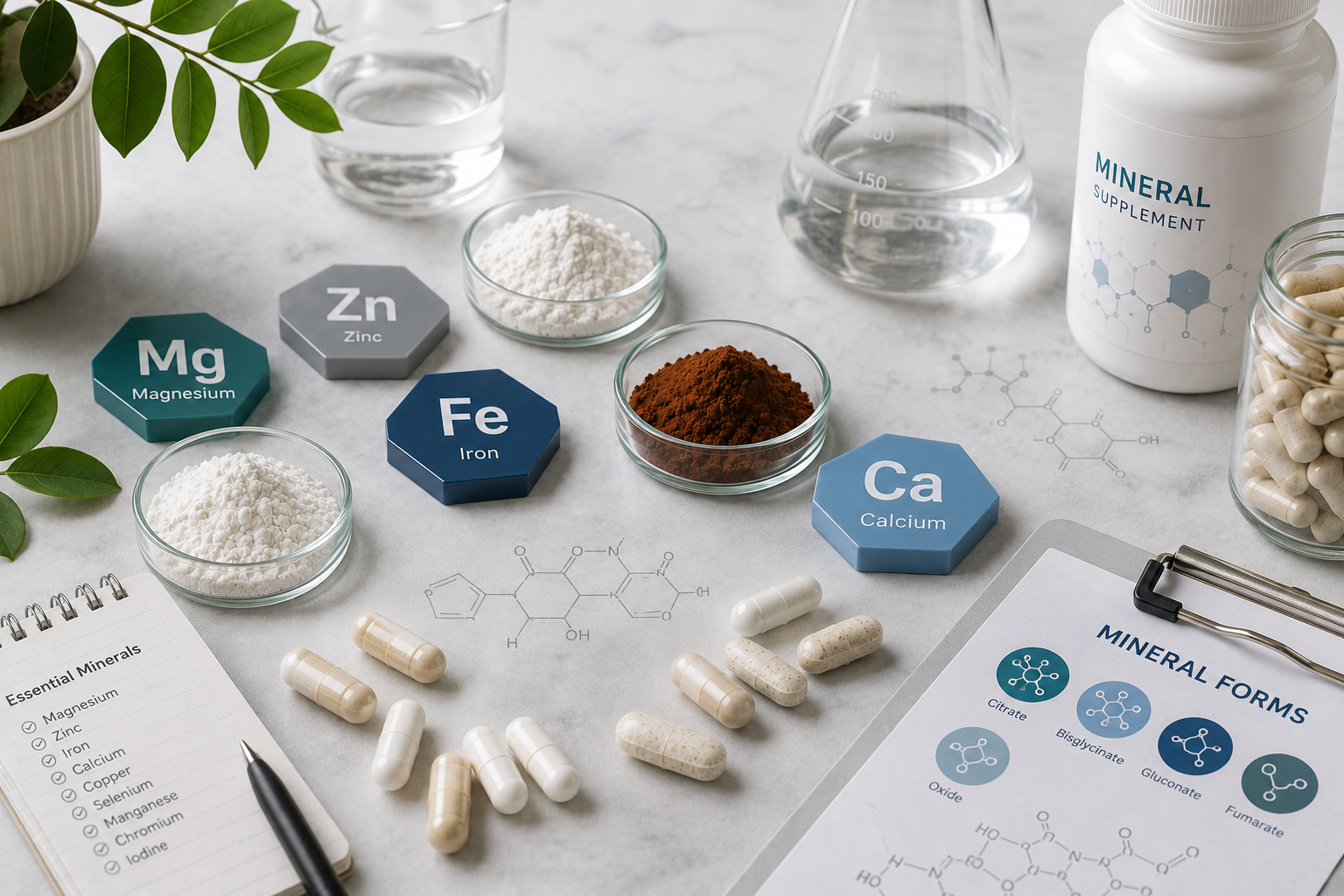
The mineral form decides how many capsules a daily serving takes, how big the tablet gets and whether the product can work as an effervescent tablet or a powder. PharmaEurope manufactures mineral supplements at its EU plant: a ready-made formula under your label from 100 units, your own formula from 500 bottles, and powders from 300 kg of finished blend. Production takes from 2 weeks, your own formula from 4 weeks, and every batch ships with a Certificate of Analysis.
| Format | Minimum order | Production time | Mineral formulas already in the catalogue |
|---|---|---|---|
| Capsules, ready-made formula with your label (white label) | From 100 units | From 2 weeks | Magnesium bisglycinate, magnesium malate, liposomal magnesium, magnesium oxide |
| Tablets, ready-made formula with your label (white label) | From 100 units | From 2 weeks | Buffered magnesium citrate, ZMA, chromium, boron |
| Capsules or tablets, your own formula (private label) | From 500 bottles | From 4 weeks, sample first | Any form or dose outside the catalogue |
| Effervescent tablets | Low minimum order, tubes of 20 tablets | From 2 weeks | Magnesium from carbonate, magnesium with potassium, effervescent calcium |
| Powders and sachets | From 300 kg of finished blend | From 2 weeks; your own formula from 4 weeks | Isotonic sports blend; magnesium blends as your own formula |
Standard shelf life is 24 months, confirmed on the specification. The plant is ISO 22000, GMP and HACCP certified and FDA registered; copies of the certificates are sent to clients on request. Every minimum is counted per product.
Which mineral form should I choose for my supplement?
Choose the form by the elemental amount you need per daily serving and by the format, not by the mineral name. The same 100 mg of magnesium can come from a small amount of a dense salt or from five times its weight of a chelate, and that difference decides the capsule count.
Minerals are rarely used as the pure element. They are supplied as salts such as oxide, carbonate, citrate or gluconate, as chelates bound to an amino acid such as glycine, or as liposomal ingredients. Each form has its own elemental content, density, taste and behaviour in the blend, so two products that declare the same mineral can be very different to make. On a mineral brief we take the decisions in this order:
- Elemental content first. The label declares the mineral; the weight in the capsule is the salt.
- Volume second. A light chelate needs more capsule space than a dense salt at the same mineral dose.
- Format third. If the daily amount does not fit in a sensible capsule count, the product moves to tablets, effervescent tablets or a powder.
- Taste last, and only for open formats. A mineral that goes unnoticed in a capsule is very noticeable in a drink.
Common mineral forms, formats and EU reference values
The table shows the usual forms of nine minerals, the formats they suit, the main production issue and the EU nutrient reference value (NRV) per day.
| Mineral | Common forms | Typical supplement formats | Main production issue | EU NRV* |
|---|---|---|---|---|
| Magnesium | Citrate, bisglycinate, malate, oxide, carbonate | Capsules, tablets, powders, effervescent tablets | High dose, capsule volume | 375 mg |
| Zinc | Citrate, bisglycinate, gluconate, picolinate | Capsules, tablets | Elemental content differs by form | 10 mg |
| Iron | Ferrous fumarate, bisglycinate, sulfate | Capsules, tablets | Colour change and compatibility | 14 mg |
| Calcium | Carbonate, citrate | Tablets, capsules, powders, effervescent tablets | Large serving size | 800 mg |
| Selenium | Sodium selenite, L-selenomethionine | Capsules, tablets | Even distribution at microgram level | 55 µg |
| Chromium | Picolinate, chloride | Capsules, tablets | Very low inclusion rate | 40 µg |
| Copper | Gluconate, bisglycinate | Capsules, tablets | Trace-level blending | 1 mg |
| Manganese | Gluconate, citrate | Capsules, tablets | Even distribution | 2 mg |
| Iodine | Potassium iodide, potassium iodate | Capsules, tablets | Stability and dose accuracy | 150 µg |
*NRVs according to Annex XIII of Regulation (EU) No 1169/2011.
How much elemental magnesium fits in one capsule?
It depends on the form. In our ready-made capsules, 500 mg of magnesium bisglycinate gives 100 mg of magnesium, 500 mg of malate gives 115 mg and 656 mg of liposomal citrate gives 75 mg, while the oxide capsule carries 500 mg of magnesium.
That is why the elemental percentage is the first line we read on a raw material specification. The nutrition table declares the elemental figure; the salt weight only tells us how full the capsule will be. Covering the full 375 mg magnesium NRV with the bisglycinate capsule would take close to four capsules a day, and that is the point where we suggest a tablet, an effervescent tablet or a powder instead.
The machines are rarely the limit. Our line fills capsules up to size 000 and presses tablets up to 25 mm, so high-milligram minerals fit. The real limit is the bulk density of the blend: a dense mineral fits a smaller capsule than a light powder at the same milligram dose. What the capsule route looks like in practice, from ready-made formulas to minimum order, is on our capsule manufacturing page.
Chelate or inorganic salt?
A chelate such as bisglycinate is bound to glycine, so most of its weight is not the mineral: 500 mg of bisglycinate carries 100 mg of magnesium. It is the form brands ask for by name, and it costs capsule space. A salt such as oxide or carbonate is denser and carries more mineral per milligram. Neither is wrong; the choice follows the dose, the format and what the label is meant to name. When a brand wants one named form on the pack, we keep that form as the only source of the mineral in the formula, as in our bisglycinate capsule.
Which magnesium supplements can I launch under my own label?
PharmaEurope already makes magnesium in capsules, tablets and effervescent tablets, so a magnesium product can start as white label from 100 units. The ready-made formulas include:
- magnesium 100 mg from 500 mg bisglycinate with vitamin B6, capsules;
- magnesium 200 mg from buffered citrate with vitamin B6 5 mg, tablets;
- magnesium 115 mg from 500 mg malate with vitamin B6, capsules;
- liposomal magnesium 75 mg from liposomal citrate 656 mg, capsules;
- magnesium 500 mg from oxide with vitamin B6, capsules;
- ZMA: magnesium 375 mg, zinc 27 mg and vitamin B6 1.4 mg, tablets;
- effervescent magnesium 200 mg from carbonate with vitamin B6 2 mg, tubes of 20 tablets.
Any other form or dose, for example bisglycinate without vitamin B6 or at a higher dose, is made as your own formula from 500 bottles. A product meant to carry an authorised EU magnesium claim needs at least 15% of the NRV, 56 mg of magnesium, per daily portion. The full formula list and the authorised wording are on our private label magnesium supplements page.
Zinc, iron, calcium and trace minerals: what is in the catalogue?
Beyond magnesium, our catalogue of more than 500 ready-made formulas covers zinc, iron, calcium, single trace minerals and electrolytes:
- zinc: zinc gluconate, liposomal zinc, zinc picolinate with copper;
- iron: iron bisglycinate, liposomal iron with vitamin C, iron complex with zinc and B12;
- calcium: calcium with magnesium and zinc, effervescent calcium;
- single nutrients: chromium and boron tablets, natural iodine from kelp extract;
- electrolytes: potassium capsules, an electrolytes complex and an isotonic sports blend.
Every category with its formulas is listed on the supplement categories page, and electrolyte formulas in powder, sachets and effervescent tablets have their own page on electrolyte and hydration supplements.
Iron
Iron is the mineral we look at hardest for colour and compatibility. Iron salts can darken a blend and interact with other actives during storage, so the iron form, its partner ingredients and the pack are chosen together, and the shelf life is confirmed on the specification of the finished product rather than borrowed from the raw material.
Trace minerals dosed in micrograms
Selenium, chromium and iodine are dosed in micrograms, so a whole batch contains very little of them. The risk is not the dose but the spread: the mineral has to be evenly distributed so that every capsule or tablet carries its share. We ask for the trace mineral in a form suited to dry blending and check the result against the specification; the batch Certificate of Analysis reports it.
What goes wrong on the line with mineral blends?
Four things: flow, volume, moisture and taste. Each one is cheaper to solve at the formula stage than on the line.
- Flow. Fine mineral powders can bridge in the hopper and fill unevenly, which shows up as weight variation between capsules or tablets. Particle size and flow are checked before the excipients are chosen.
- Volume. A low bulk density forces a bigger capsule or more capsules per serving.
- Moisture. Some mineral salts and effervescent bases pull water from the air, which can cake a powder or start an effervescent reaction early.
- Taste. Zinc, iron and magnesium salts are easy to taste in a drink, so open formats need a flavour system.
In an effervescent tablet the mineral becomes part of the reaction chemistry. Our effervescent magnesium uses carbonate as the magnesium source, each tablet weighs 4 g on a sorbitol base, and the tube of 20 tablets has a moisture-absorbing cap. Certain mineral forms suit effervescent tablets better than others because of their solubility and their fit with the acid-base system.
See private label effervescent tablet manufacturing for the mineral forms that dissolve cleanly.
Powders take the doses that do not fit in capsules: a magnesium or electrolyte blend in a jar or a single-serve sachet, from 300 kg of finished blend. The details are on our private label powder manufacturing page.
What do we ask the mineral supplier for?
A specification that states the elemental content, and a Certificate of Analysis for the lot we receive. Before a mineral raw material is approved for a formula, we check that the documents cover:
- the elemental content as a percentage of the ingredient;
- the chemical form and the name it will carry on the label;
- particle size and bulk density;
- moisture or loss on drying;
- heavy metals and microbiology;
- allergen and GMO statements;
- storage conditions.
Chelates are the case to watch. A raw material sold under a chelate name can be a mix of chelate and salt, and the specification has to say which, because the label names the form.
Which packaging protects a mineral supplement?
The pack follows the most moisture-sensitive ingredient in the formula: a bottle, with a desiccant where needed, a blister or a tube.
Our blister line forms PVC/PVDC and PVC/Aclar laminates and cold-formed aluminium for formulas that pull moisture or oxidise, and effervescent tablets go into tubes with a moisture-absorbing cap. Standard shelf life is 24 months, confirmed on every specification. For the background, see our guide on Packaging Systems in Supplement Manufacturing.
FAQ
What is elemental mineral content?
Elemental content is the amount of the mineral itself inside a compound. In the PharmaEurope bisglycinate capsule, 500 mg of magnesium bisglycinate supplies 100 mg of magnesium. The label and the nutrition table declare the 100 mg, so compare mineral products by the elemental figure, not by the weight of the salt.
Which mineral form should I choose?
No single form suits every product. PharmaEurope chooses the form from the elemental dose per serving, the format and what the label should name: a chelate when the brand wants bisglycinate on the pack, a denser salt when a high dose has to fit in few capsules, a carbonate in an effervescent tablet.
What is the minimum order for a mineral supplement?
A ready-made mineral formula with your label starts from 100 units. Your own formula in capsules or tablets starts from 500 bottles, powders and sachets from 300 kg of finished blend, and effervescent tablets have a low minimum order in tubes of 20 tablets. PharmaEurope counts every minimum per product.
How long does production of a mineral supplement take?
PharmaEurope produces a ready-made mineral formula under your label from 2 weeks; effervescent tablets, sachets and powders also take from 2 weeks. Your own formula takes from 4 weeks, because a sample is made and approved first. Standard shelf life is 24 months, confirmed on the specification of each product.
Can the same mineral be used in capsules, tablets, powders and effervescent tablets?
Often yes, but not always in the same form. PharmaEurope makes magnesium as bisglycinate and malate in capsules, buffered citrate in tablets and carbonate in effervescent tablets. Each format has its own limit on volume, flow, moisture or taste, so the form is chosen for the format, not the other way round.
Can a mineral supplement carry a health claim?
Only an authorised EU claim, in its authorised wording, and only when the daily portion provides at least 15% of the NRV; for magnesium that is 56 mg. PharmaEurope checks the artwork against Regulation (EU) No 432/2012 before printing. The authorised magnesium wording is listed on our magnesium page.
What documents come with a mineral supplement batch?
Every PharmaEurope batch ships with a Certificate of Analysis, and the specification of each product is available on request. The plant is ISO 22000, GMP and HACCP certified and FDA registered, which is a registration, not an approval. Copies of the certificates are sent to clients on request.
Sources
- Regulation (EU) No 1169/2011 on food information to consumers, Annex XIII: nutrient reference values for minerals and the significant amount of 15% of the NRV.
- Regulation (EU) No 432/2012 establishing a list of permitted health claims made on foods.
- PharmaEurope catalogue of ready-made formulas and the private label magnesium supplements page: formulas as named in the catalogue.
- PharmaEurope manufacturing equipment page: capsule sizes, tablet diameter and blister films.
Last checked: 26 October 2026.
Thinking about your own product? Tell us the format, the active and its dose, and how many units you need for the first run. Ready-made formulas start from 100 units, and we reply within 24 hours, Monday to Friday.
Written by the PharmaEurope manufacturing team at the ISO 22000-certified plant in the European Union. Last reviewed 26 October 2026.
Where this is made
Request a quoteReady-made formulas from 100 units. We reply within 24 hours, Monday to Friday.
Read next
 Private label vitamin D3 + K2 and vegan vitamin D3PharmaEurope makes private label vitamin D3 + K2 in softgels, tablets and effervescent tubes of 20, and vegan vitamin D3 from algae, at our EU plant. White label starts from 100 units, standard own-label runs from 500 bottles (500 pcs for stock softgels), your own brand on a ready-made formula is in production from 2 […]27 October 2026
 Why vitamin D is a strong first product for your supplement brandVitamin D is a strong first product for a new supplement brand because the ingredient is well known to buyers, the product is taken every day and the EU allows seven authorised health claims for it. PharmaEurope manufactures private label vitamin D in its certified EU plant: white label on a ready-made formula from 100 […]27 October 2026
 What vitamin D does and what an EU label may sayIn the EU, what vitamin D does may be stated on a supplement label only in the seven authorised health claims of Regulation (EU) No 432/2012, for example "Vitamin D contributes to the maintenance of normal bones", and only when a daily serving supplies at least 15 % of the 5 µg NRV, which is […]27 October 2026